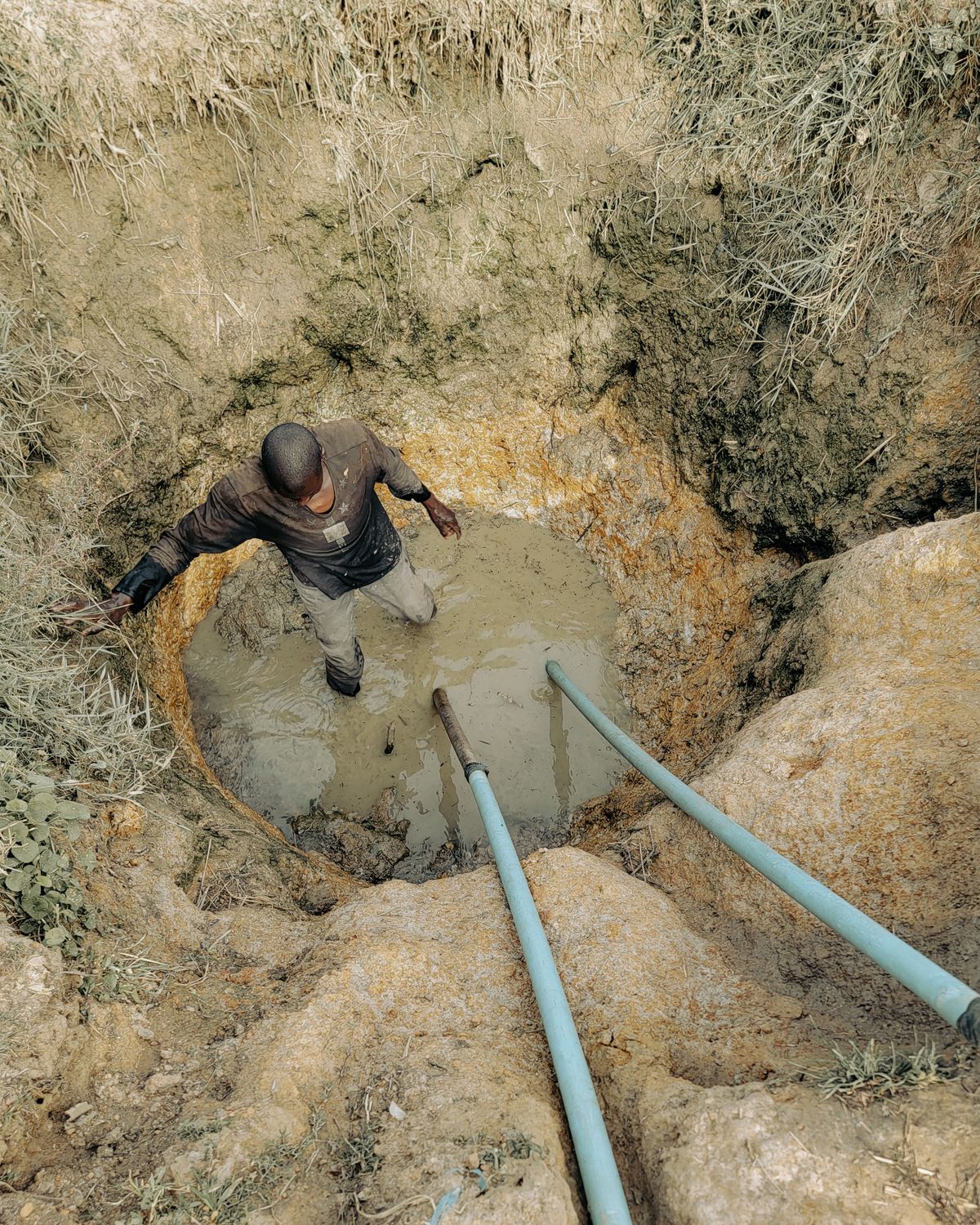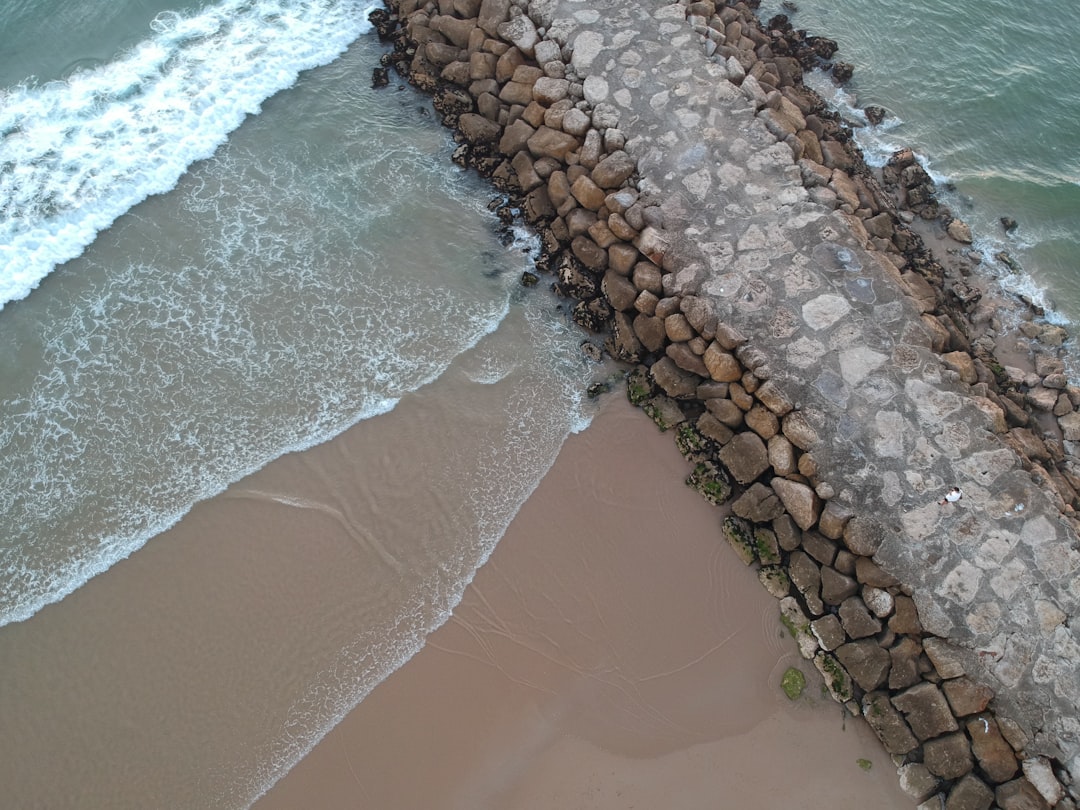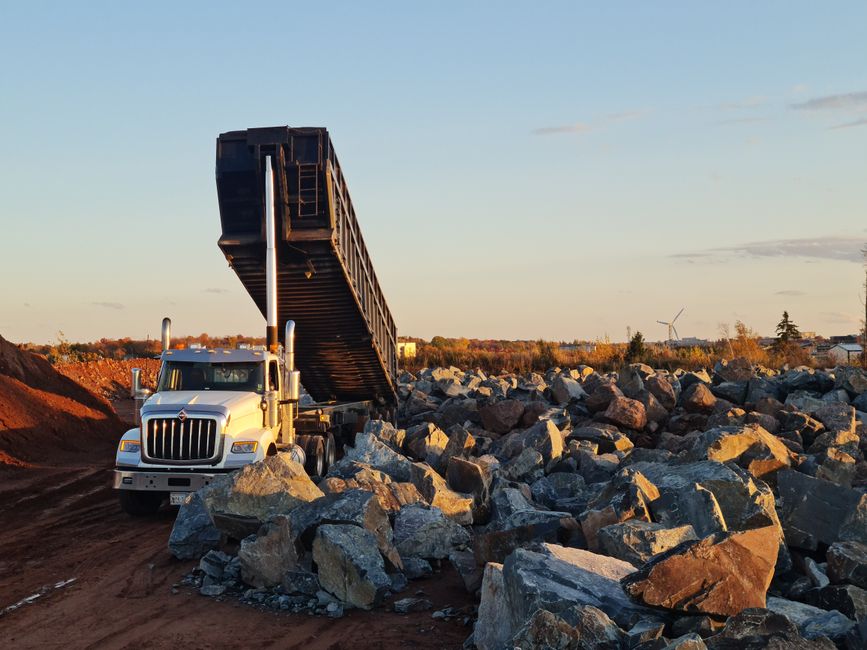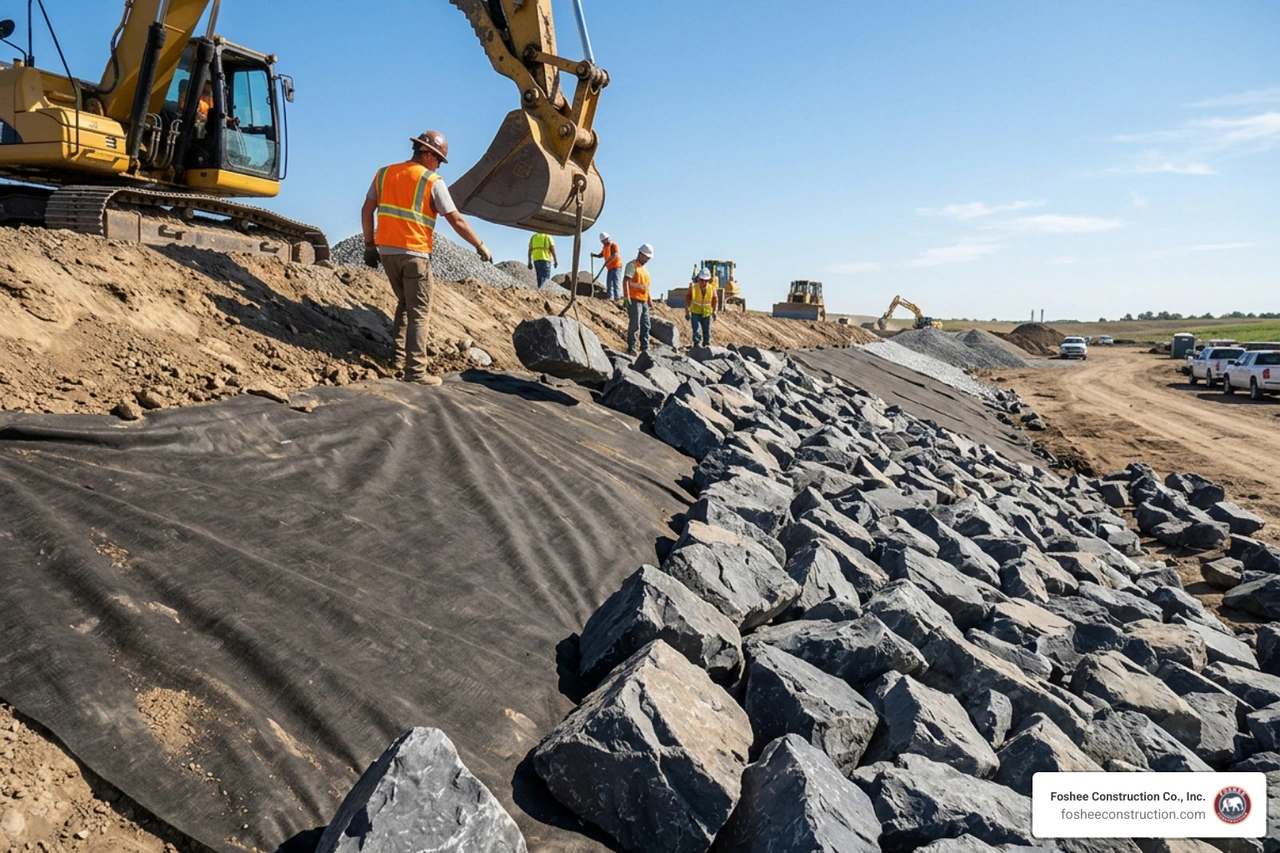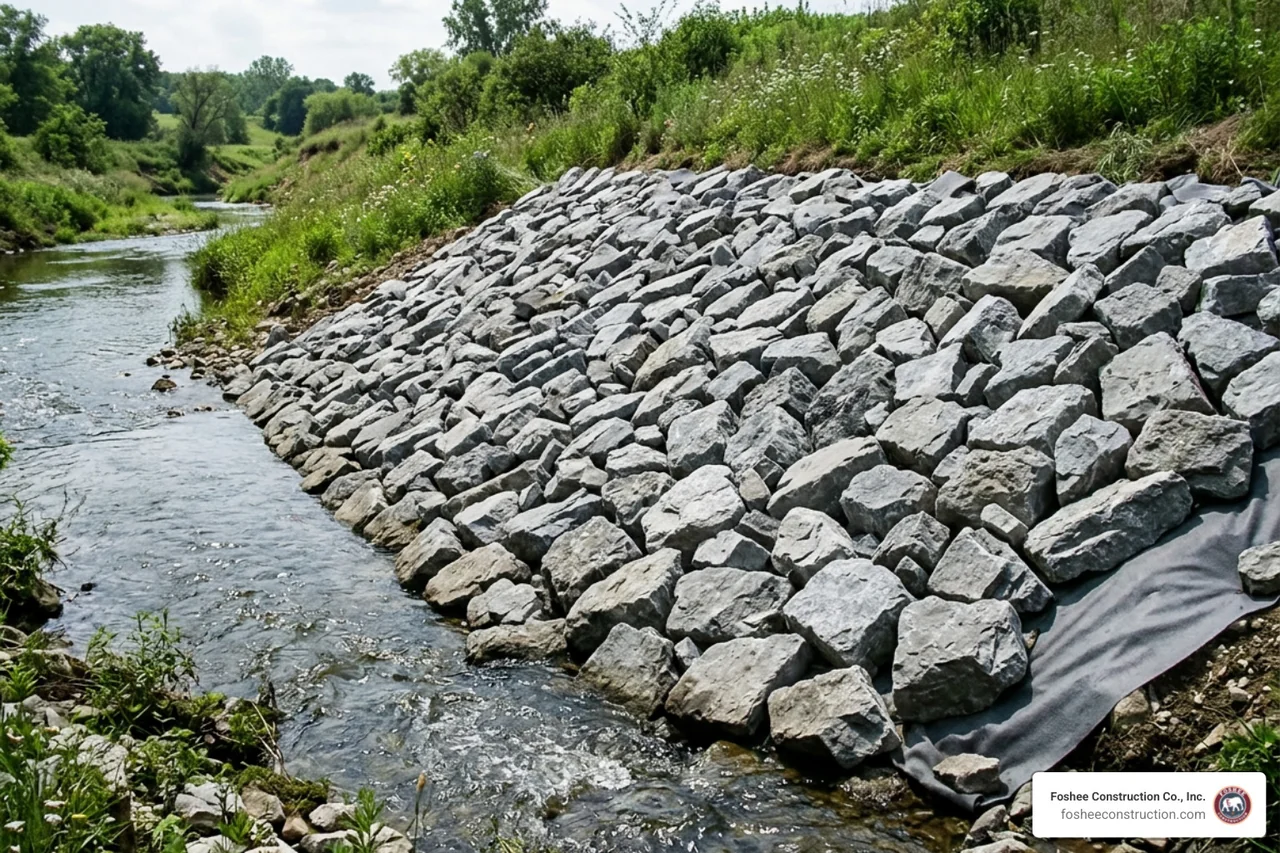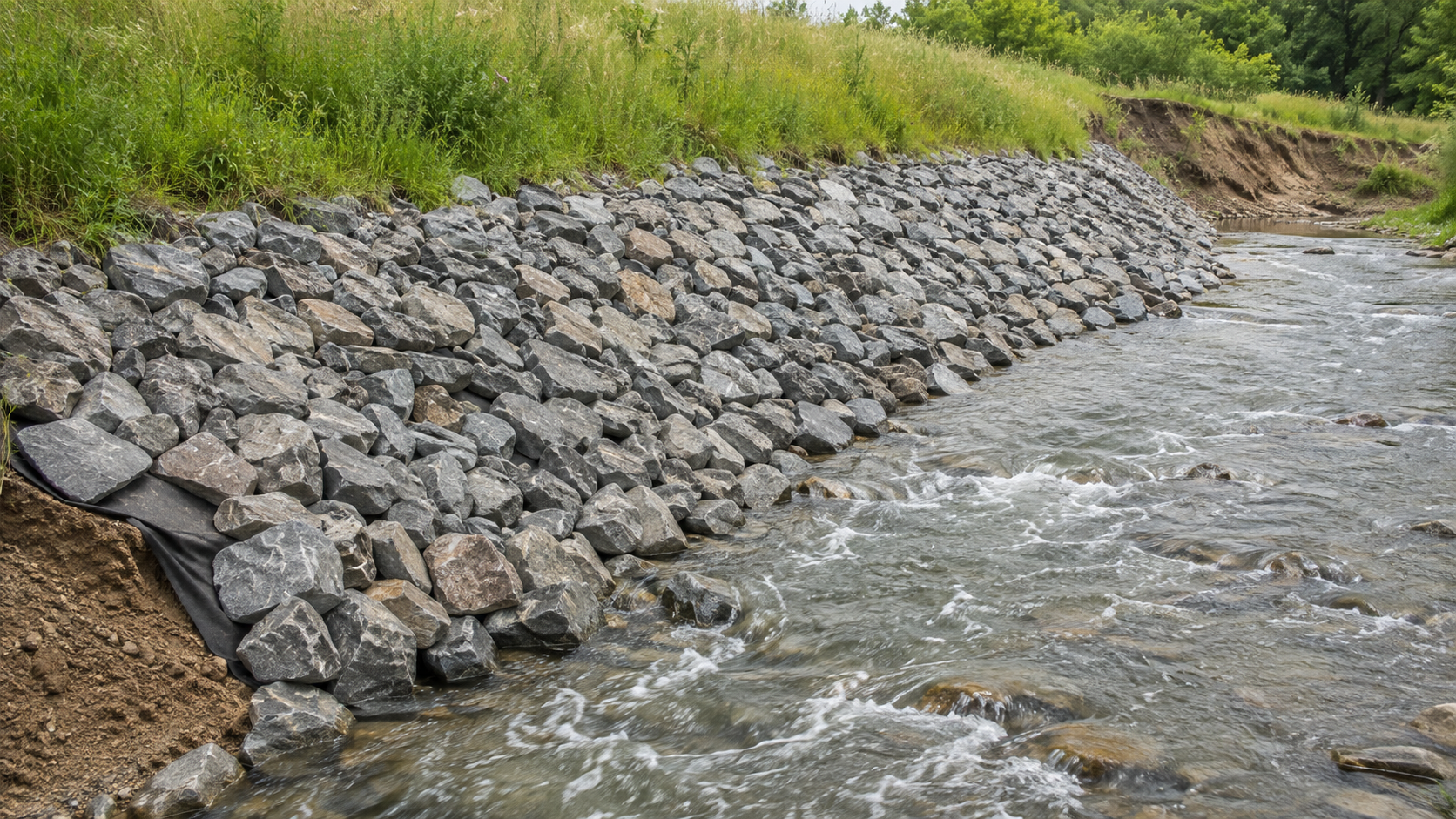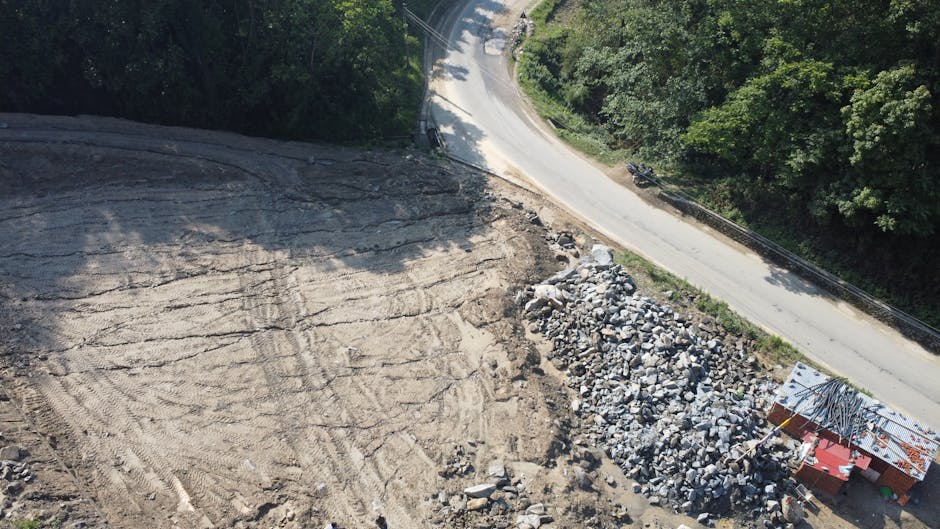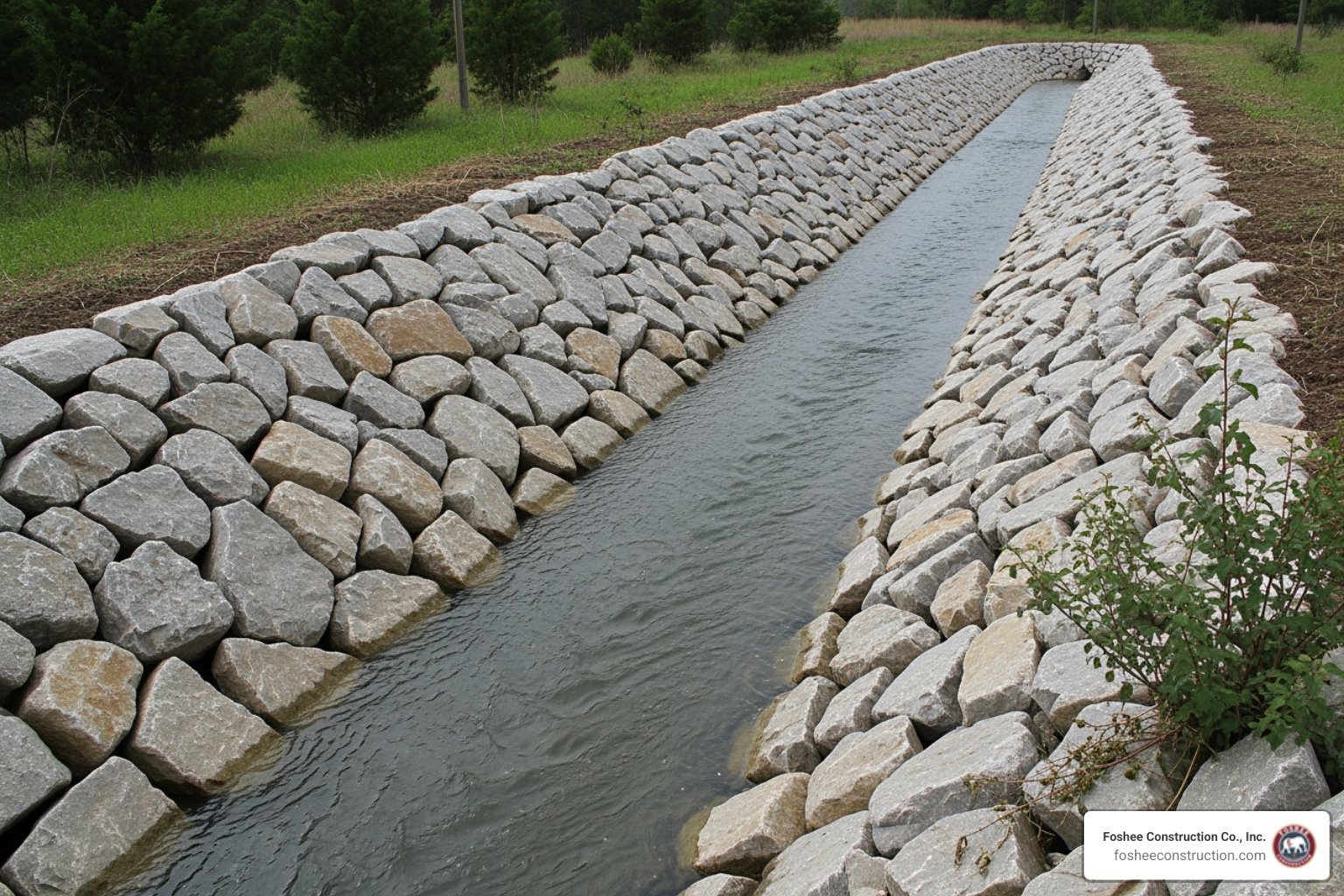
Riprap is a protective layer of large, angular stone placed on a prepared slope, bank, shoreline, or drainage channel to resist erosion and scour. It works by breaking up the force of moving water, waves, and runoff while holding the soil beneath it in place.
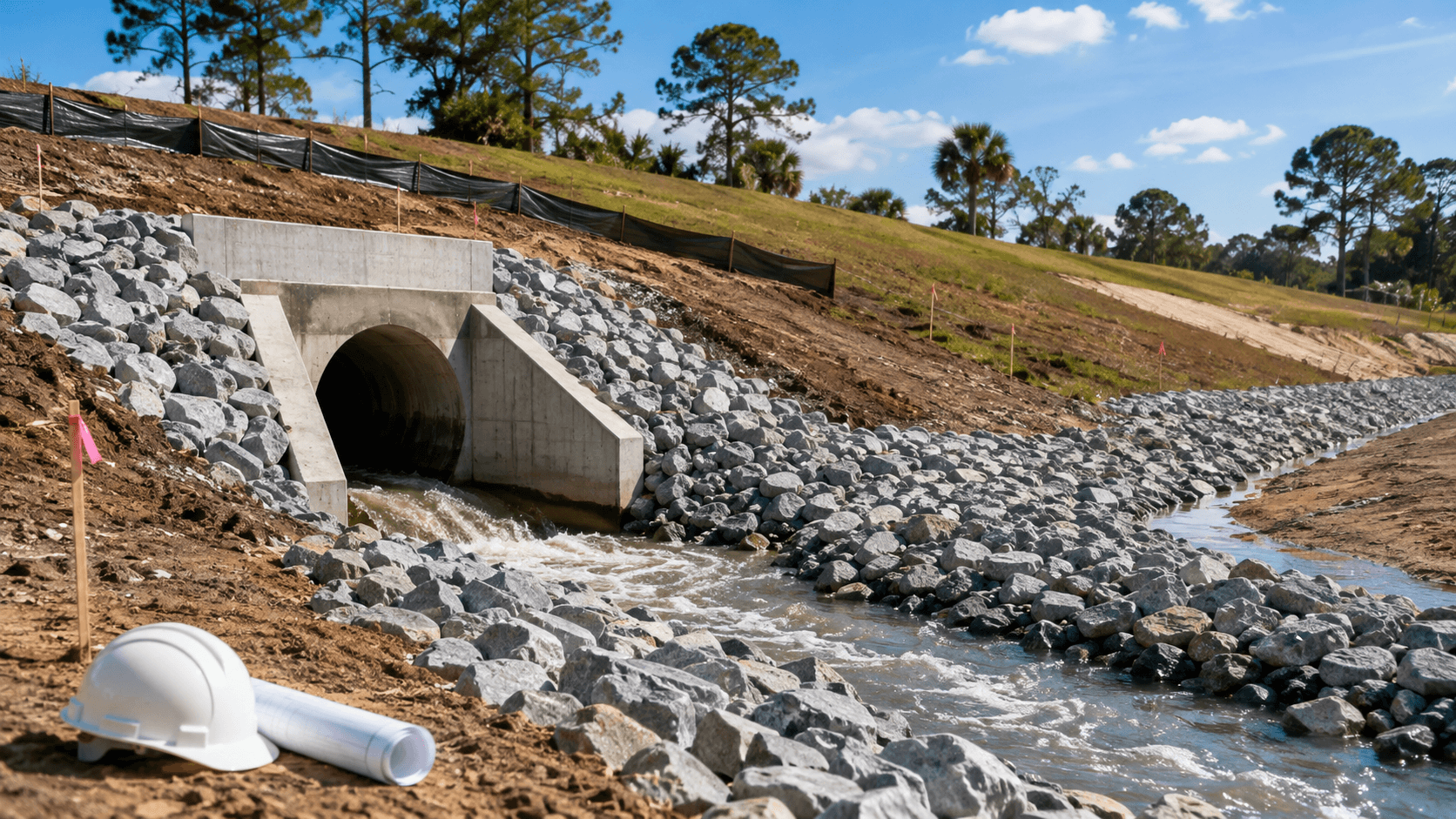
For Florida construction projects, riprap is often used at stormwater outfalls, detention ponds, culvert aprons, canal banks, and shorelines where fast water could wash out a slope or damage nearby infrastructure. A properly designed system includes the right stone size, a well-graded rock mix, stable toe protection, and a filter layer such as geotextile or granular bedding to keep fine soil from washing through the gaps.
It is not just a matter of dumping rock on a bank. Poor sizing, missing filter fabric, steep slopes, or an unprotected toe can shift the problem downstream or cause the stone blanket to settle and fail. Good design also weighs site access, permitting, maintenance needs, and practical options such as vegetated riprap or other bioengineered controls.
I am Don Larsen of Foshee Construction Co., Inc., where our team has supported Central Florida site development since 1994 through grading, drainage, excavation, and erosion-control work. That field experience helps us view riprap as part of a complete, reliable site-preparation and stormwater-management system.
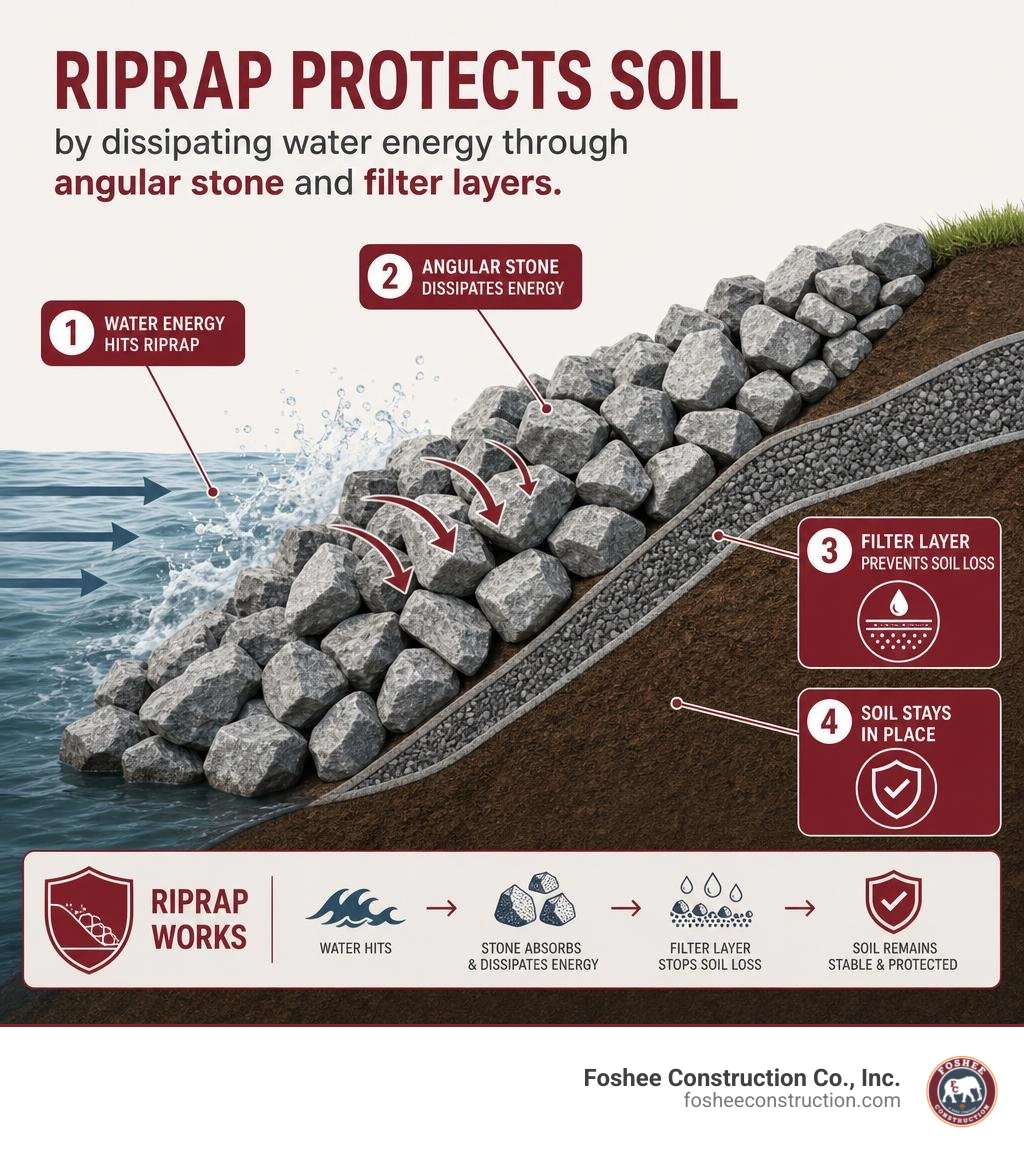
Across civil engineering and heavy site development, rock armour serves as a foundational line of defense against turbulent hydraulic forces. According to the standard Riprap definition, it consists of durable, unconsolidated rock fragments placed strategically along exposed earthen profiles to absorb kinetic impacts. You might hear it called shot rock, quarry stone, or rubble depending on the region, but its mission remains constant: locking soil firmly in position against rushing currents.
Understanding what is riprap and why its used in erosion control requires looking at its structural composition. Rather than acting as a rigid, impermeable barrier like poured concrete, riprap functions as a flexible matrix. This flexibility allows the individual rocks to adjust dynamically to minor ground settling while continuing to diffuse fluid energy through inter-particle friction.
The performance of any revetment begins with raw geological material. High-density igneous rock, hard quarry granite, and durable crushed limestone are standard choices. For permanent installations, the stones must possess high specific gravity and resistance to physical weathering.
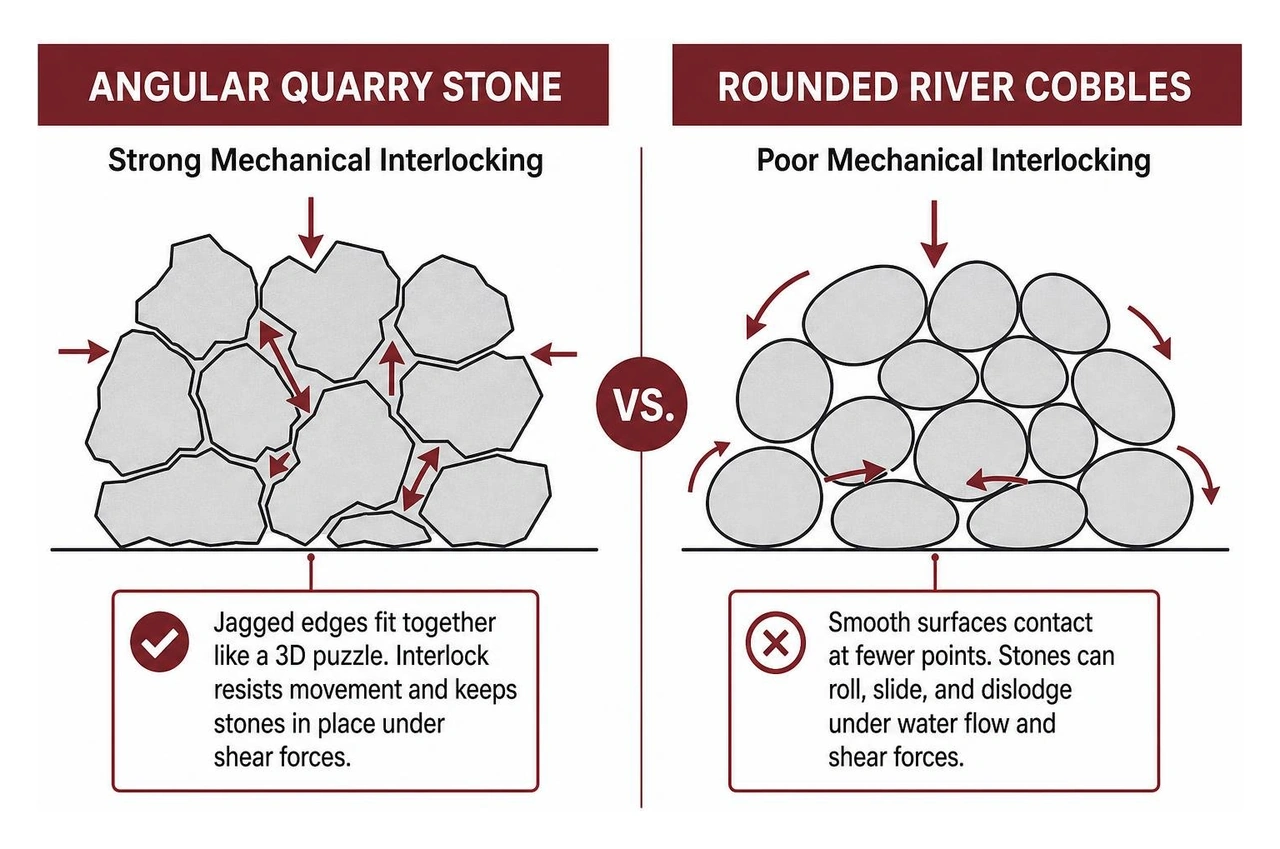
Stone angularity is crucial. Rounded river cobbles may look pleasant in garden beds, but placing smooth stones on a high-velocity slope is an invitation for catastrophic sliding. Angular stone fragments feature jagged, fractured edges that fit together like pieces of a 3D puzzle, creating mechanical interlocking. This interlock prevents individual stones from dislodging under heavy shear stresses.
The stone blanket must also be well-graded. A well-graded mixture combines large boulders with medium and small rocks to fill interstitial spaces. This balances the void ratio, preventing turbulent water from slicing directly into the subgrade. While recycled concrete rubble from demolition is sometimes considered for budget reasons, natural quarry rock remains the superior choice for consistent density and long-term environmental safety.
State departments of transportation establish rigorous classification frameworks to match rock gradations to hydrological demands. In Florida, the Florida Department of Transportation (FDOT) categorizes riprap under specific weight and application brackets rather than simple diameter sizing:
| Classification / Application | Nominal Stone Weight / Size Range | Typical Hydraulic Flow Velocity | Primary Project Application |
|---|---|---|---|
| Florida Rubble (Ditch Lining) | 4 lbs to 75 lbs | Up to 8.5 ft/s | Stormwater ditches, swales, retention pond inlets |
| Florida Rubble (Bank & Shore) | 60 lbs to 670 lbs | 8.5 ft/s to 12.0+ ft/s | Canal banks, lakefront revetments, bridge piers |
| Bedding Stone | 1 inch to 12 inches | Layer / Cushion application | Granular filter underlayment below rubble |
| Gabion Rock | 3 inches to 8 inches | Variable (enclosed in wire) | Steep slopes (>2:1), channel walls, drop structures |
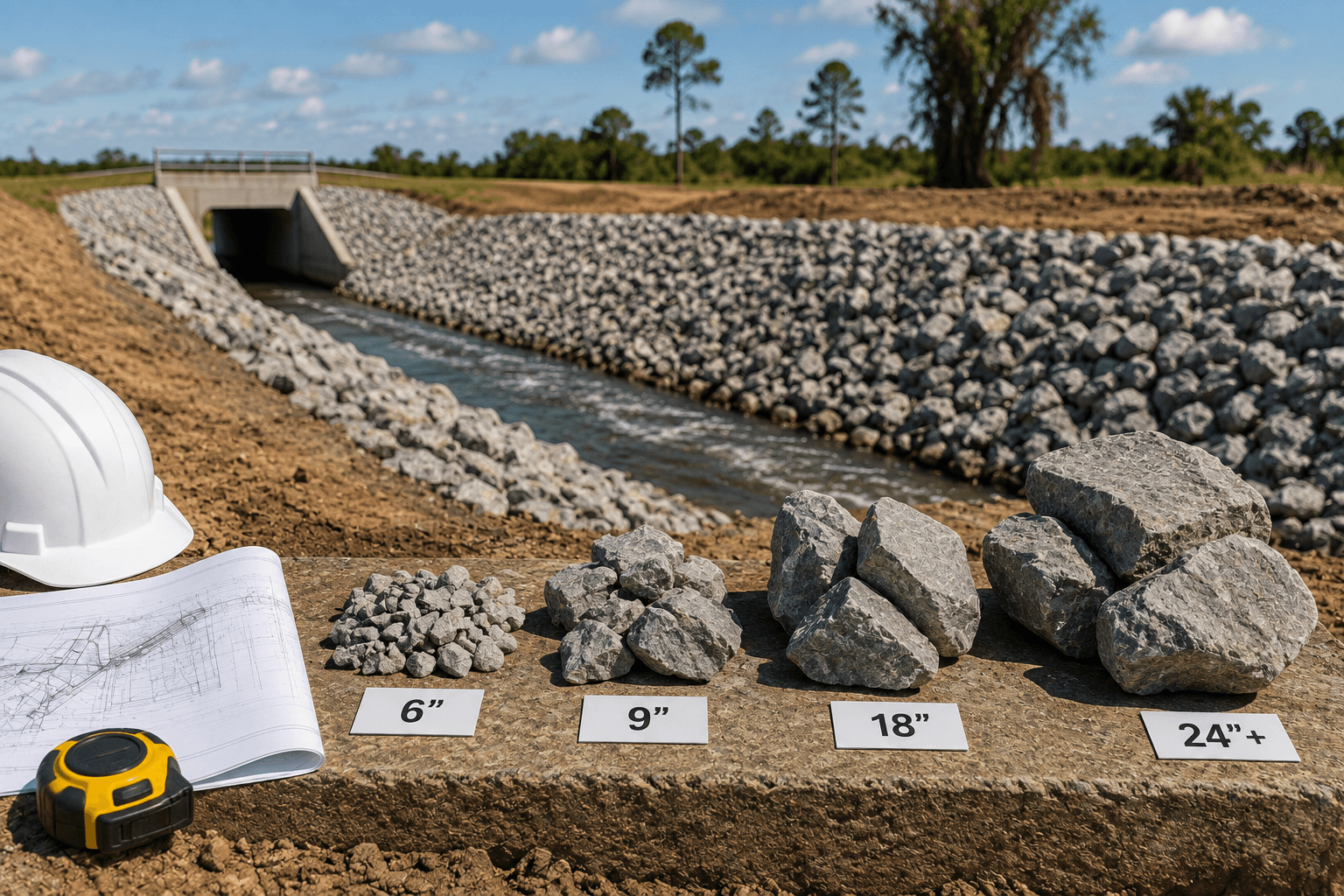
| Class I Random Riprap | 6-inch maximum ($d_{max}$) | Up to 5.0 ft/s | Low-velocity outfalls, gentle pond side slopes |
| Class V Heavy Riprap | 36-inch maximum ($d_{max}$) | Up to 15.0 ft/s | High-discharge spillways, severe wave impact zones |
Choosing the appropriate category prevents structural washout during extreme rainfall events. Random riprap Class I typically costs around $64.10 per cubic yard, while Class V averages $71.64 per cubic yard. Hand-placed riprap requires meticulous labor and can reach upwards of $750.00 per cubic yard. For specialized slopes, articulated concrete blocks offer an alternative averaging $75.51 per square yard.
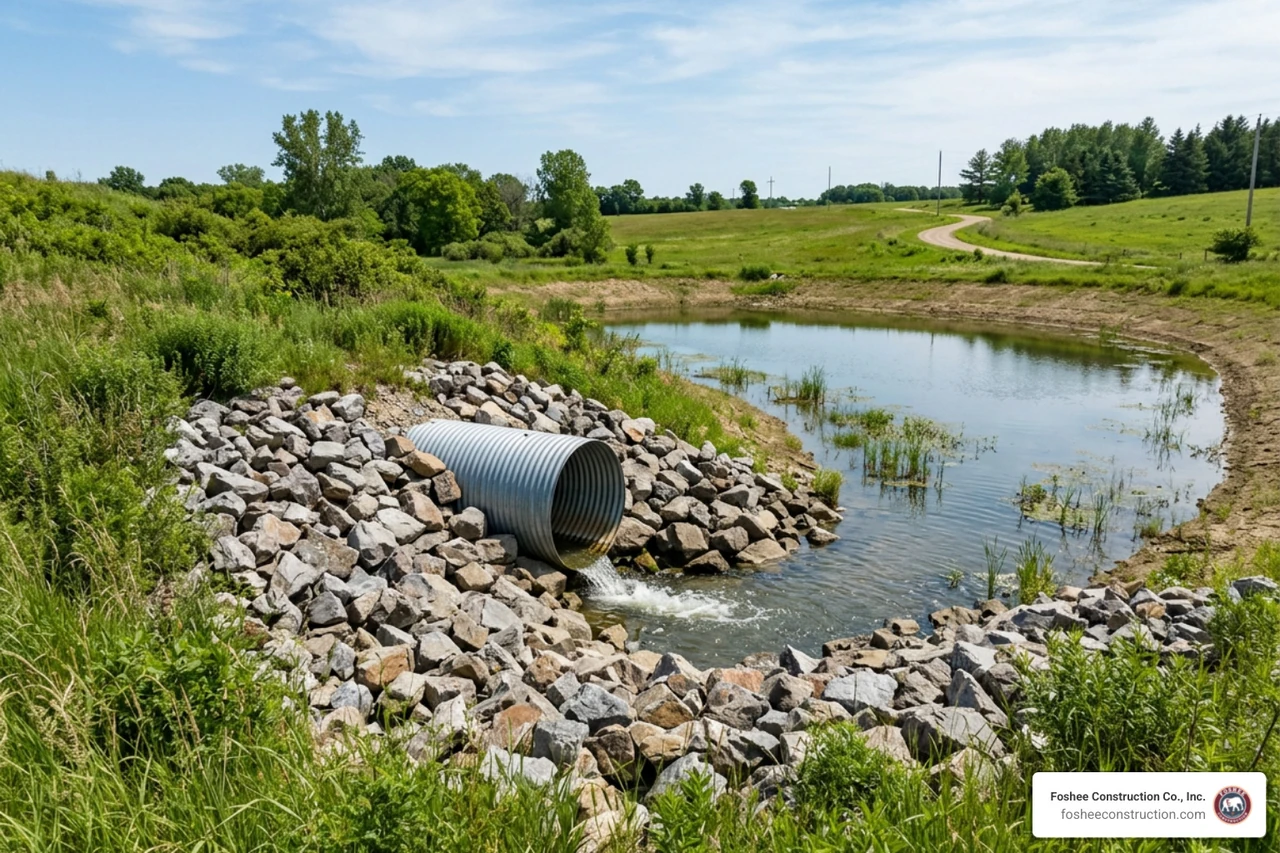
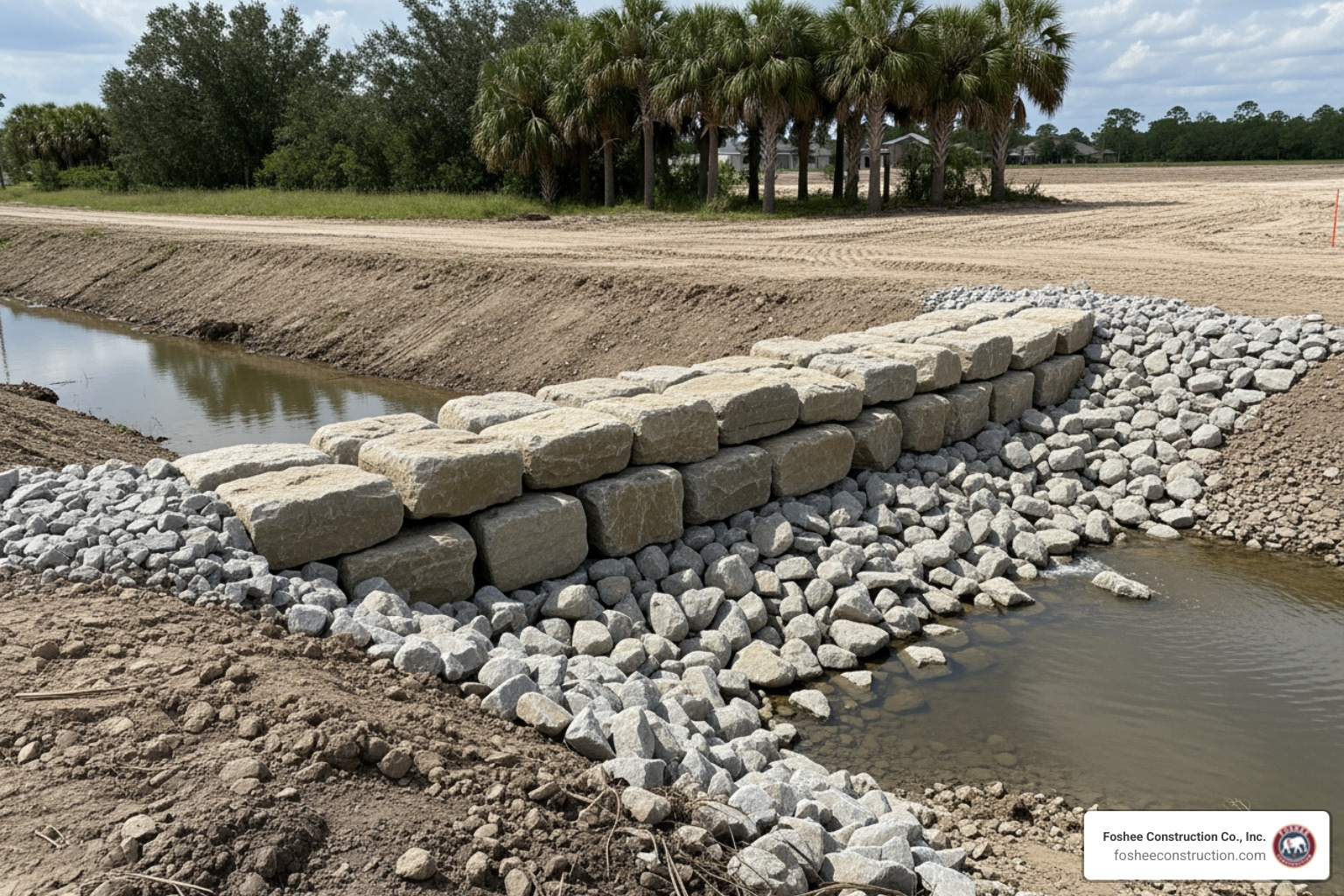
We deploy riprap wherever moving water generates enough shear stress to exceed the shear strength of bare soil or native sod. In temporary construction phases, we might integrate erosion control rock check dams across open channels to slow concentrated runoff. In permanent designs, the stone acts as a rugged energy dissipation apron that converts rapid, scouring flows into tranquil, subcritical water discharge.
High-energy waterways exert relentless pulling forces against civil infrastructure. Bridge abutments and foundational piers are especially prone to local scour—a phenomenon where swirling underwater vortexes excavate sediment directly beneath concrete foundations. Heavy quarry stone placed around bridge piers breaks up these vortices and armors the riverbed.
Along lakefronts, retention basins, and canals, wind-driven wave action and boat wakes batter exposed banks. Over time, this causes the lower slope to erode, leading to sudden bank collapse. Placing an engineered rock revetment absorbs kinetic energy, protects highway embankments parallel to open water, and reinforces aging seawall footings against toe failure.
Storm sewer outfalls and culvert pipes discharge massive volumes of concentrated stormwater during Central Florida cloudbursts. When this high-velocity water exits a smooth concrete barrel, it violently hits the natural soil. Without intervention, an outfall creates a deep plunge pool that eats backward, destabilizing the pipe headwall.
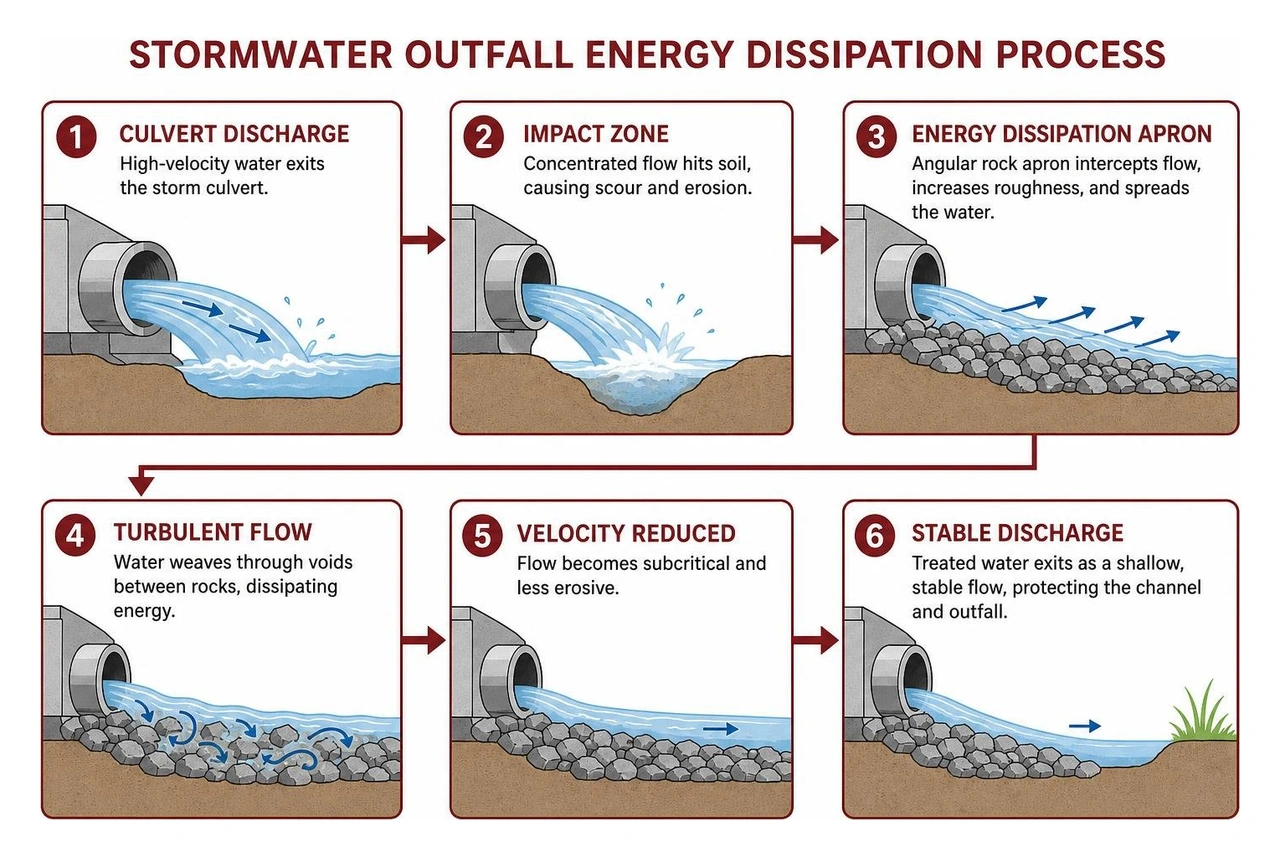
Constructing an energy dissipation apron using angular stone creates surface roughness that slows the torrent. In large-scale earthwork operations involving sediment basin installation fl, armoring inflow chutes and overflow emergency spillways prevents basin walls from washing out when full capacity is reached.
A high-performing rock revetment requires deliberate geotechnical and hydraulic engineering. We adhere strictly to standard guidelines such as the DESIGN OF RIPRAP REVETMENT manual (HEC-11) developed by the Federal Highway Administration. These engineering standards emphasize subgrade excavation, blanket thickness, toe depth, and underlayment filtration.
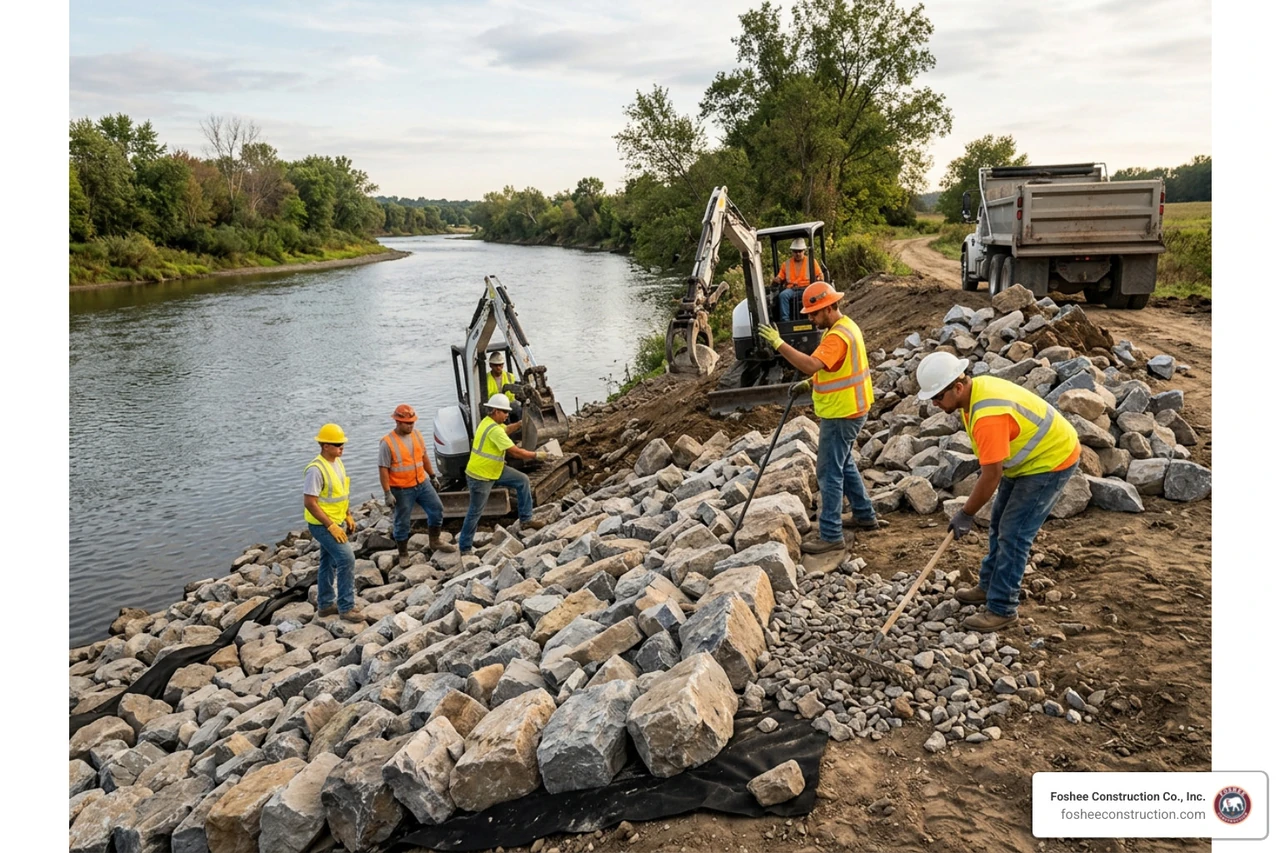
Partnering with an experienced grading and drainage contractor ensures the bank slope is cut cleanly to a stable angle of repose before the first stone is placed. The overall rock blanket thickness must reach at least 80 percent of design specifications at any single point and maintain an average depth of at least 95 percent across the revetment footprint.
Rock sizing is never a guessing game; it is directly calculated from expected water velocities and boundary shear stresses. Civil engineers calculate the $D_{50}$ median stone diameter—the size at which 50 percent of the stone mixture by weight is smaller:
Refer to our detailed guide on choosing the right riprap size for your drainage project to ensure your design parameters match local hydraulic tractive forces.
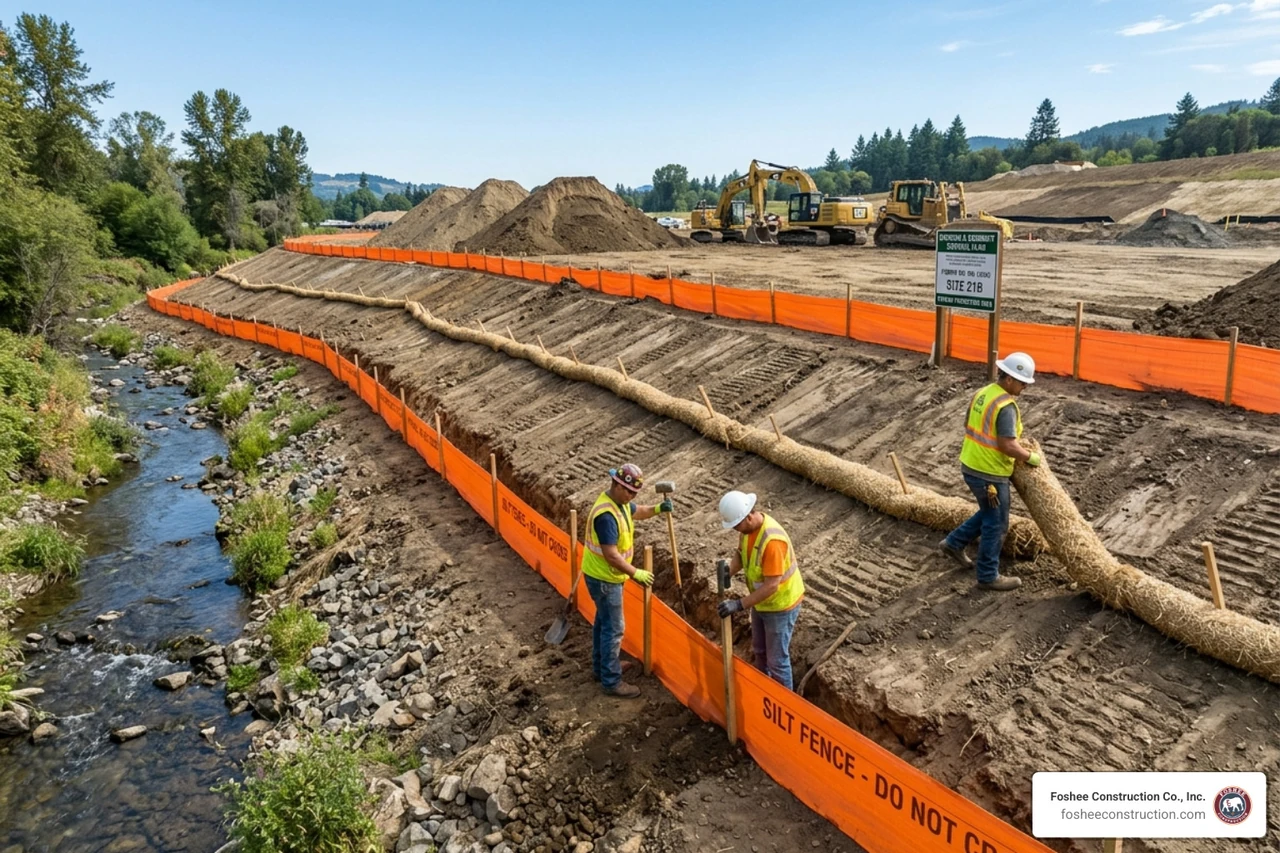
Placing heavy boulders directly onto raw sand or clay is one of the most common installation mistakes. Water surging in and out of the stone voids will rapidly pump underlying soil particles through the rocks—a failure process known as soil piping. Within a few seasons, hollow caverns form under the rock, causing the entire stone layer to collapse.
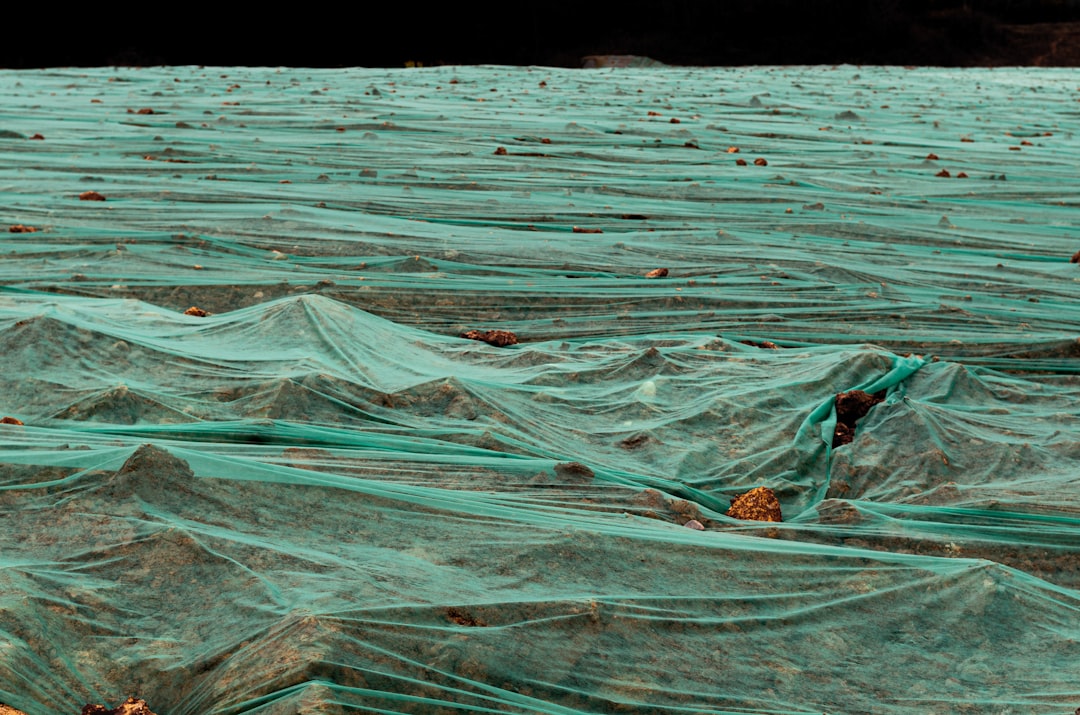
To prevent this, we install a nonwoven geotextile filter fabric or a 6-inch granular bedding layer beneath the stone. The fabric acts as a permeable barrier: it allows groundwater to seep out freely (preventing hydrostatic pressure buildup) while holding subgrade soil firmly in place.
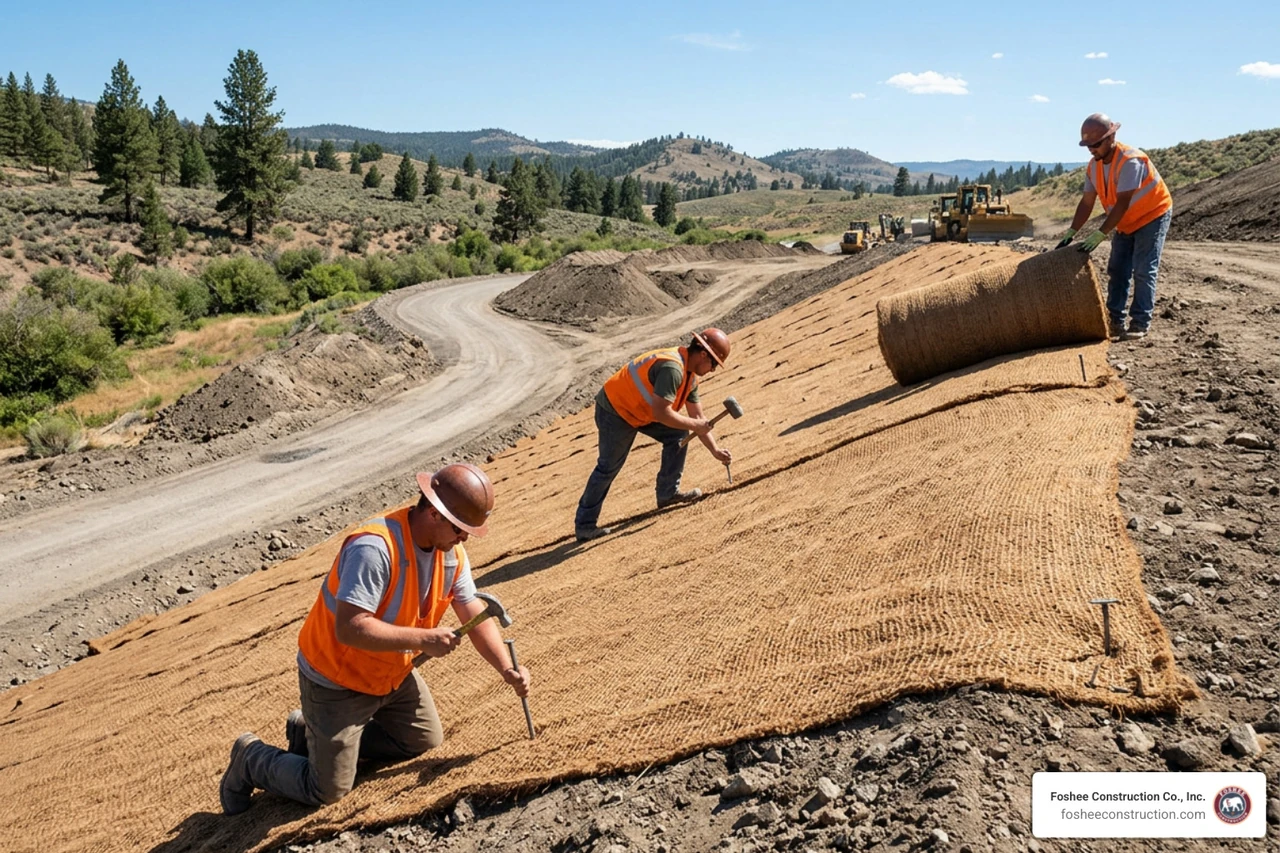
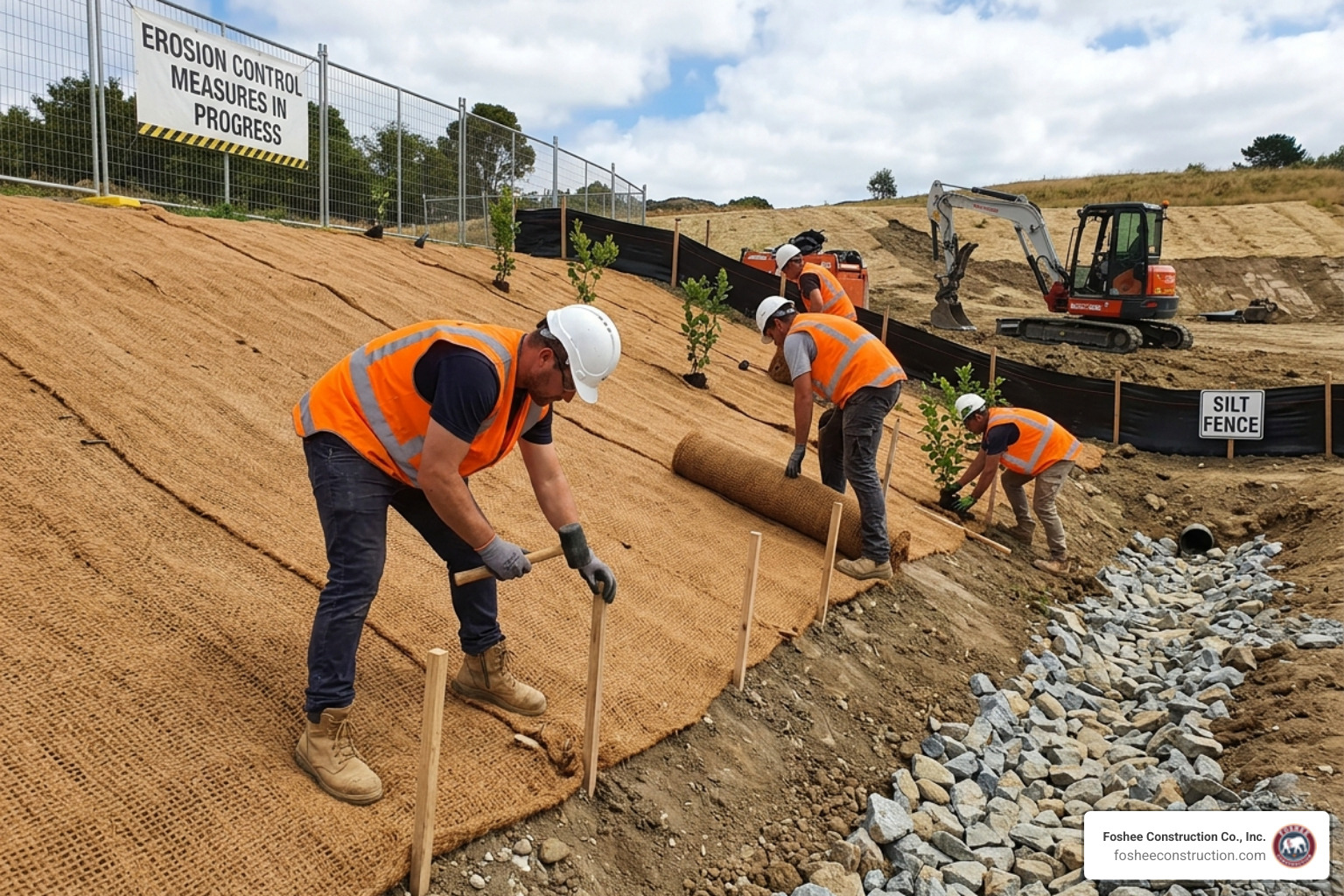
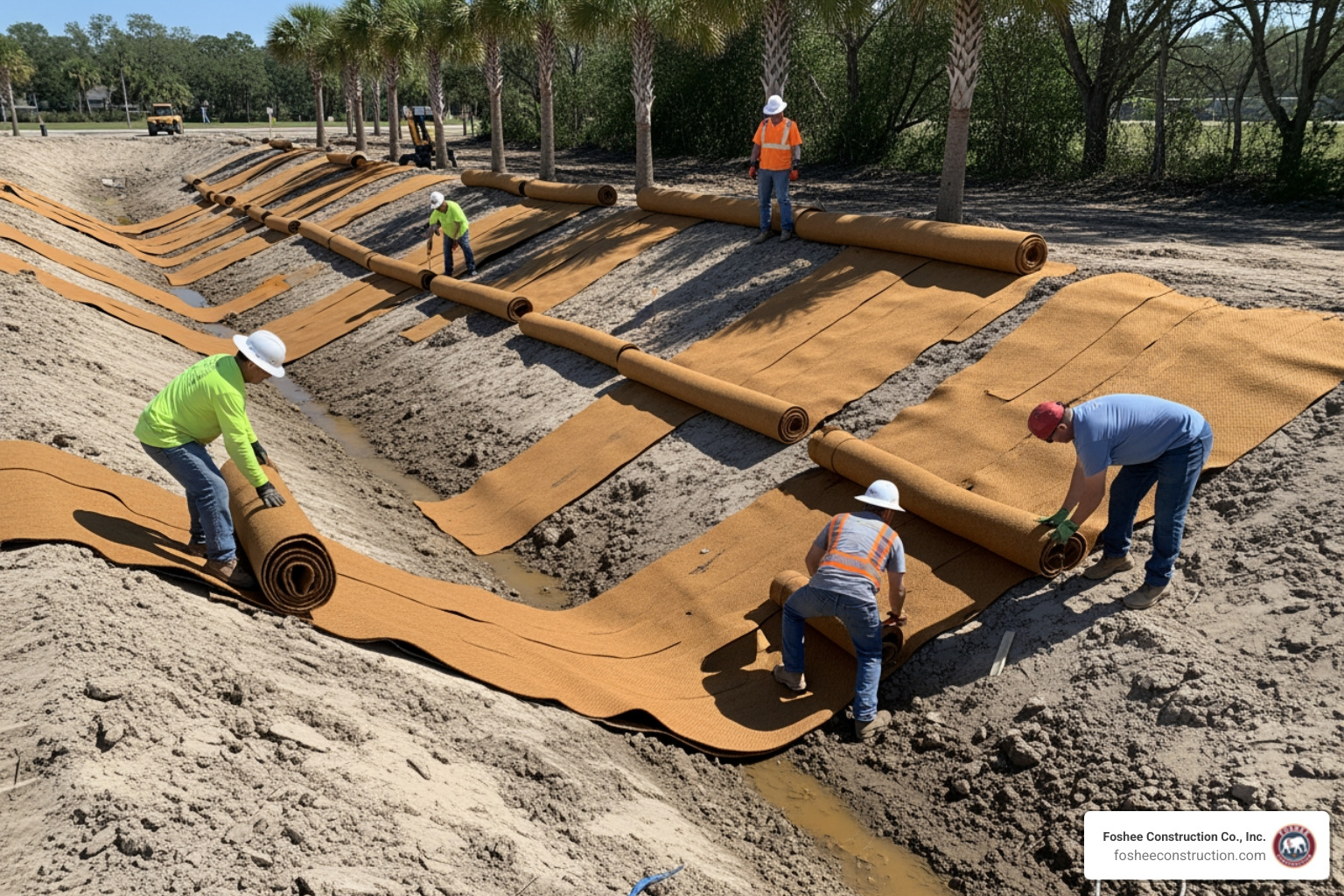
Following proper erosion control blanket installation guide principles, fabric sheets must overlap by at least 1.5 feet in the direction of water flow and be securely pinned into anchor trenches along the crest of the slope. When placing rock over fabric, drop heights must be restricted to 1 foot or less (or up to 3 feet if a 6-inch granular cushion is present) to prevent tearing the underlayment.
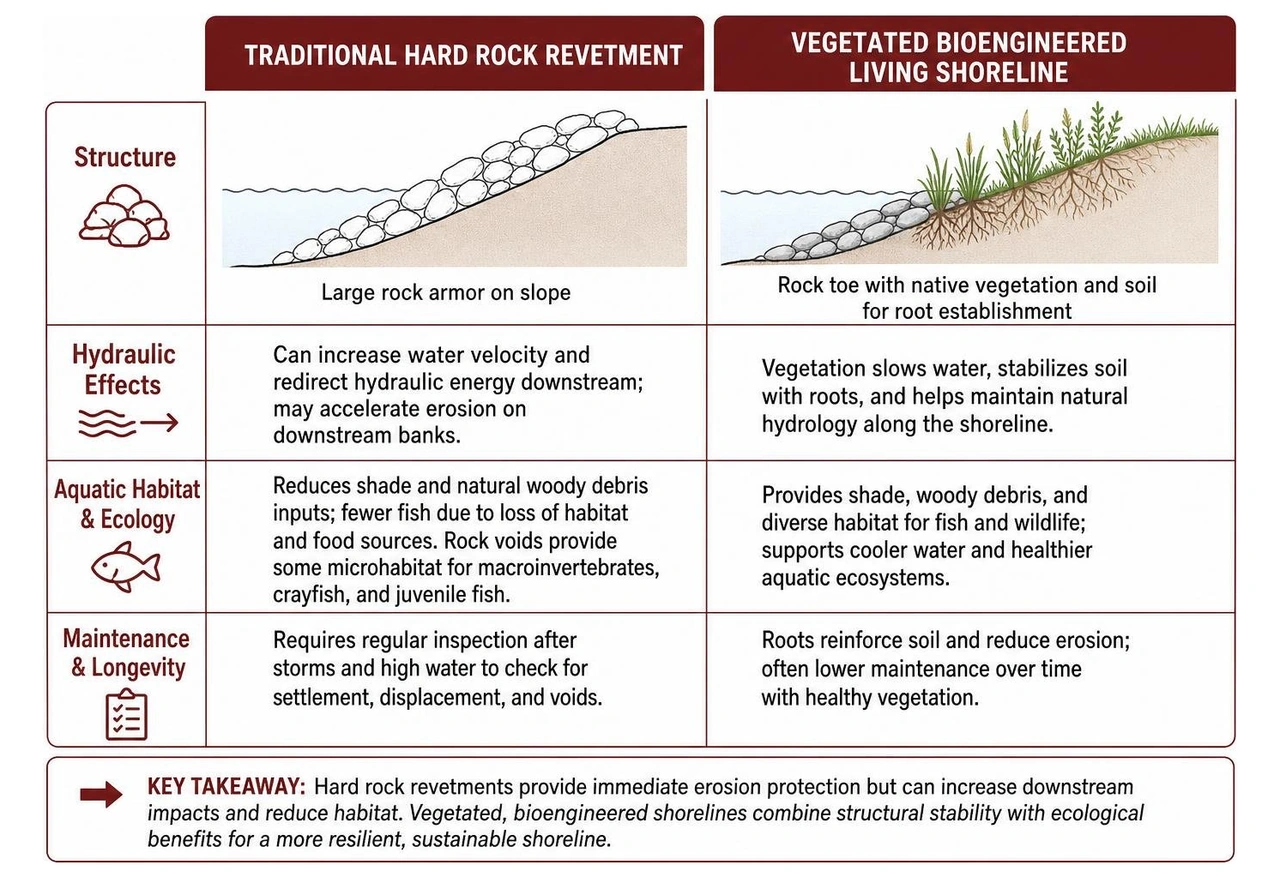
While rock armoring excels at stopping erosion, hard-armoring banks modifies local hydrology and aquatic ecosystems. The Riprap guidance from the EPA stresses that civil designers should weigh both structural benefits and downstream environmental trade-offs.
When natural, meandering shorelines are lined with hard rock, water velocity can increase, redirecting hydraulic energy downstream. Without proper transitional design, armoring one property can accelerate bank erosion on neighboring downstream banks.
Ecologically, pure stone revetments replace native shoreline canopies. This loss of shade can increase water temperatures (thermal loading) and reduce natural woody debris inputs. Studies show fewer fish in areas with riprap due to loss of natural habitat and food sources. However, the rocky voids do provide localized microhabitats that support benthic macroinvertebrates, crayfish, and juvenile fish seeking refuge from open water predators.
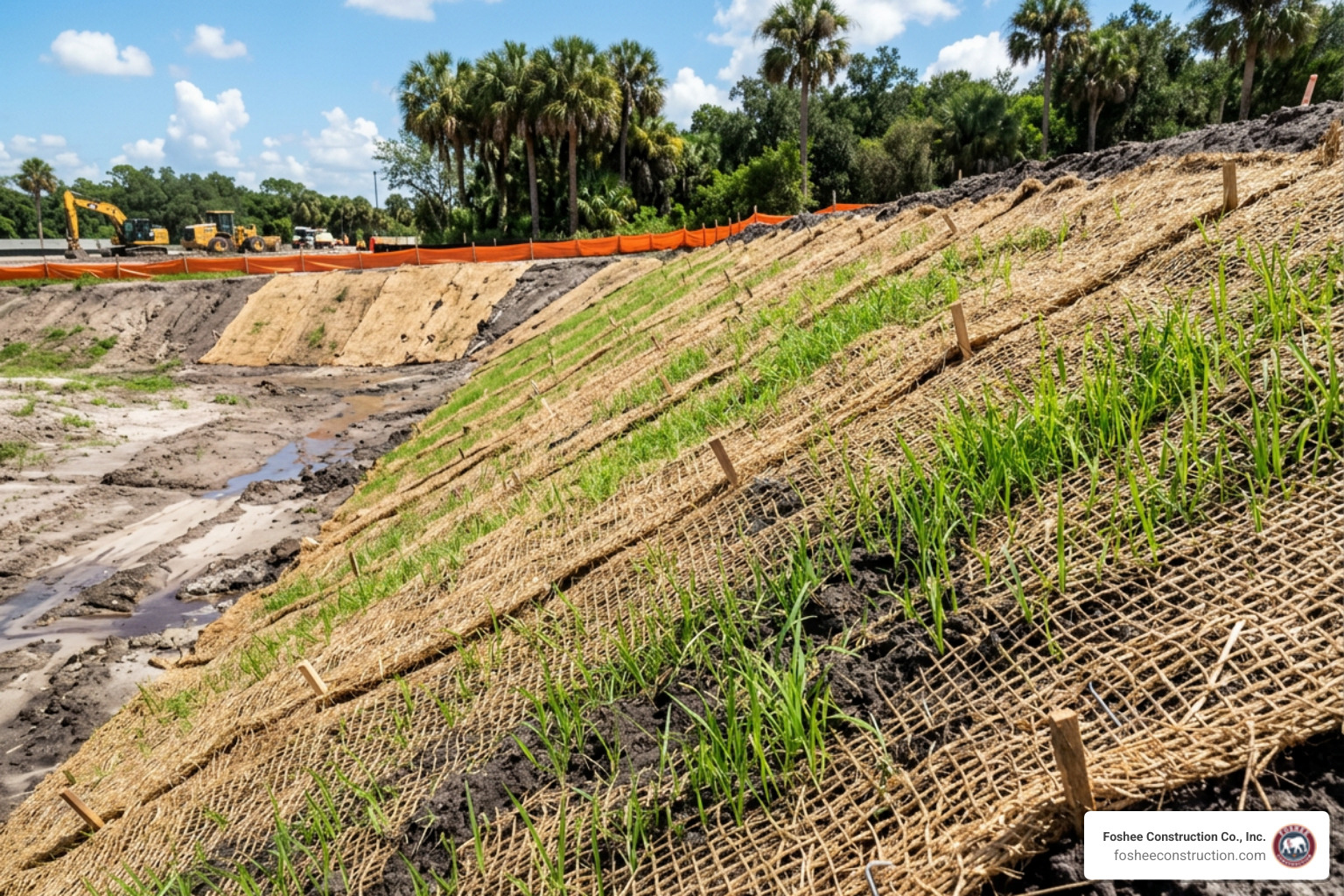
Modern engineering embraces soft bioengineering methods to create hybrid revetments that combine structural stone with native plants:
Even the most robust stone revetments require regular inspection to ensure longevity. We recommend comprehensive monitoring immediately following major storm events, tropical depressions, and seasonal high-water periods.
Understanding how stone revetments fail allows for early intervention before full bank collapse occurs:
When inspecting revetments, check the following components:
For commercial and residential developments across Lake County, hiring professional site preparation contractors ensures correct installation from the start, avoiding costly structural repairs down the road.
The maximum recommended finished slope for standard loose dumped stone is 2:1 (horizontal to vertical), with 3:1 being the optimal target for long-term geotechnical stability. Slopes steeper than 2:1 are highly vulnerable to gravitational translational slides unless secured in wire-enclosed gabion baskets.
Filter fabric acts as a separation barrier that allows groundwater to drain freely while preventing underlying subgrade soil from piping out through the stone voids. Without geotextile fabric, the base soil will wash away, causing settling, voids, and revetment collapse.
In Florida, work conducted along natural lakes, rivers, and wetlands falls under the regulatory jurisdiction of the Florida Department of Environmental Protection (FDEP) and local Water Management Districts (such as SJRWMD or SWFWMD). While minor repairs or short lengths under specific linear feet thresholds may qualify for general permits or exemptions, significant installations below the Ordinary High Water Level (OHWL) require formal environmental resource permitting to ensure safe wetland protection.
Rock revetments remain one of the most reliable, cost-effective solutions for hydraulic energy dissipation, bank stabilization, and infrastructure scour defense. Success depends on proper aggregate selection, sizing based on velocity, geotextile underlayment, and deep toe embedment.
At Foshee Construction Co., Inc., we combine heavy equipment capability with deep knowledge of Central Florida soils, hydrology, and environmental guidelines. Whether armoring an outfall, building retention basins, or stabilizing vulnerable slopes, our team delivers disciplined, long-lasting site preparation. Explore our dedicated resources on erosion control rip rap to discuss your next civil earthwork or drainage project with our specialists.
We build bids using HeavyBid and AGTEK because the details matter long before the job starts. When the numbers are accurate and the scope is clearly defined, it sets the tone for how the entire project runs. Estimating isn’t just a step in the process, it’s the foundation we build on.
That same mindset carries into the field. Our crew is trained to work with purpose, follow the Civil Engineers’ Plan to the finest detail, and hold the line on quality. When expectations are clear from day one, there’s no need for shortcuts, and no confusion about how the work gets done.
Clients trust our bid packages because they’re complete and ready to use. Project managers know what we’re covering, what’s excluded, and how we plan to approach the job. That clarity removes friction and lets teams focus on execution instead of interpretation.
As part of our review process, we go into the plans before anything hits the site. We ask the questions early, resolve issues before they show up in the field, and keep RFIs moving. This approach prevents delays and protects the timeline.
Over time, that consistency builds trust. Many of the people we work with today came through referrals from past projects – engineers, GCs, and superintendents who’ve seen how we operate and want the same experience again.
In 2024, Foshee Construction was acquired by Saga Infrastructure Solutions, a national network of civil construction companies. Saga supports regional contractors by giving them access to better tools, long-term resources, and operational backing, without changing how they run day to day.
Foshee will continue to operate under its name, with the same team and field leadership in place.
“From the very time a project starts, we start that partnership. We try to catch as much as we can with the tools that we have. Not everybody is using the software platforms we are. That’s the differentiator: we’re not just bidding. We’re anticipating, problem-solving, and making sure the job runs right.”
— Don, CEO, Saga Infrastructure Solutions
Foshee is now part of a broader regional strategy that includes Florida, the Piedmont Atlantic, Texas, Colorado, and the Arizona Sun Corridor. The name, crews, and standards remain. What’s improving is the support behind it.