Sourcing Local Rip Rap: Sizing, Delivery Costs, and Quarry Pickup

Find local rip rap near me with our guide to sizing, delivery costs, and quarry pickup for erosion control projects.

Understanding Rip Rap Material Types and Gradation Sizes

If your crew is comparing results for the search term "rip rap near me," property owners and contractors typically choose between local aggregate supply yards (best for quantities under 10 tons) and direct quarry freight delivery (most economical for commercial truckloads). Bulk rip rap generally costs between $65.00 and $90.00 per ton or cubic yard, with sizing ranging from versatile 4-to-8-inch stones up to 12-to-24-inch heavy armor boulders depending on flow velocity and project requirements.

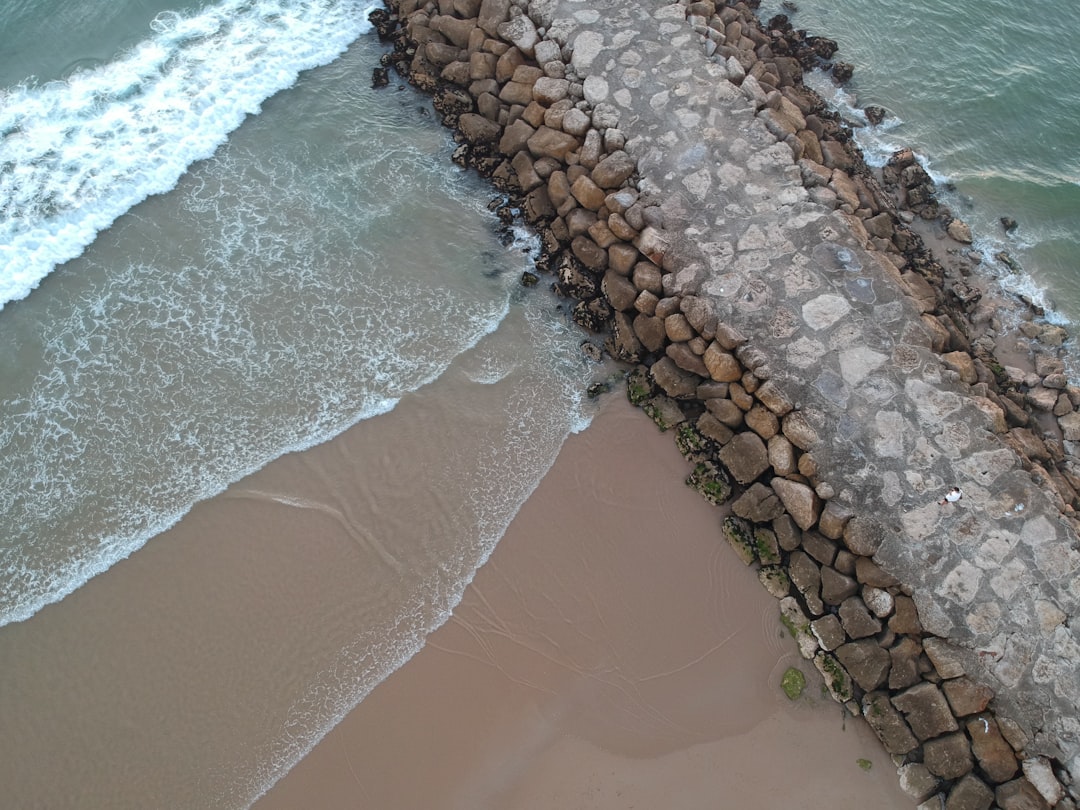
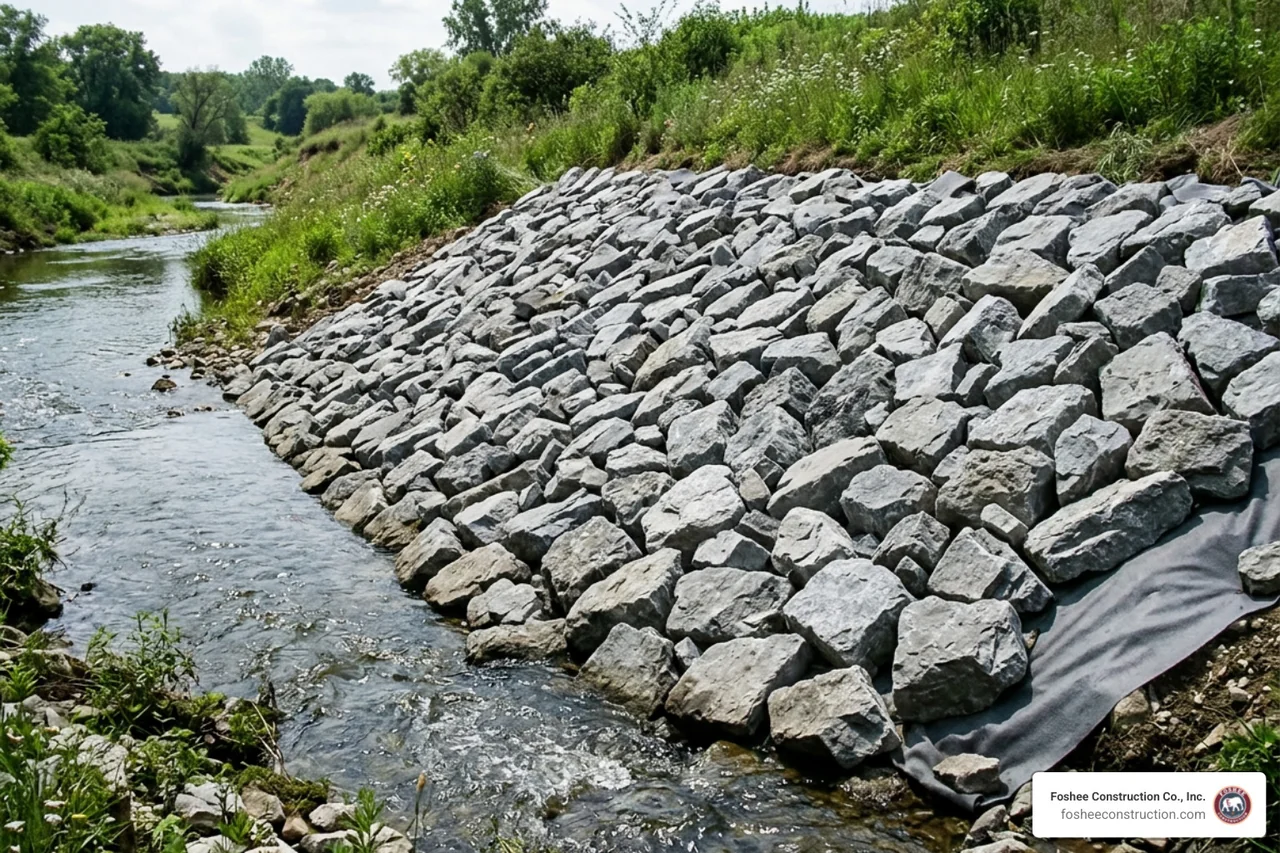
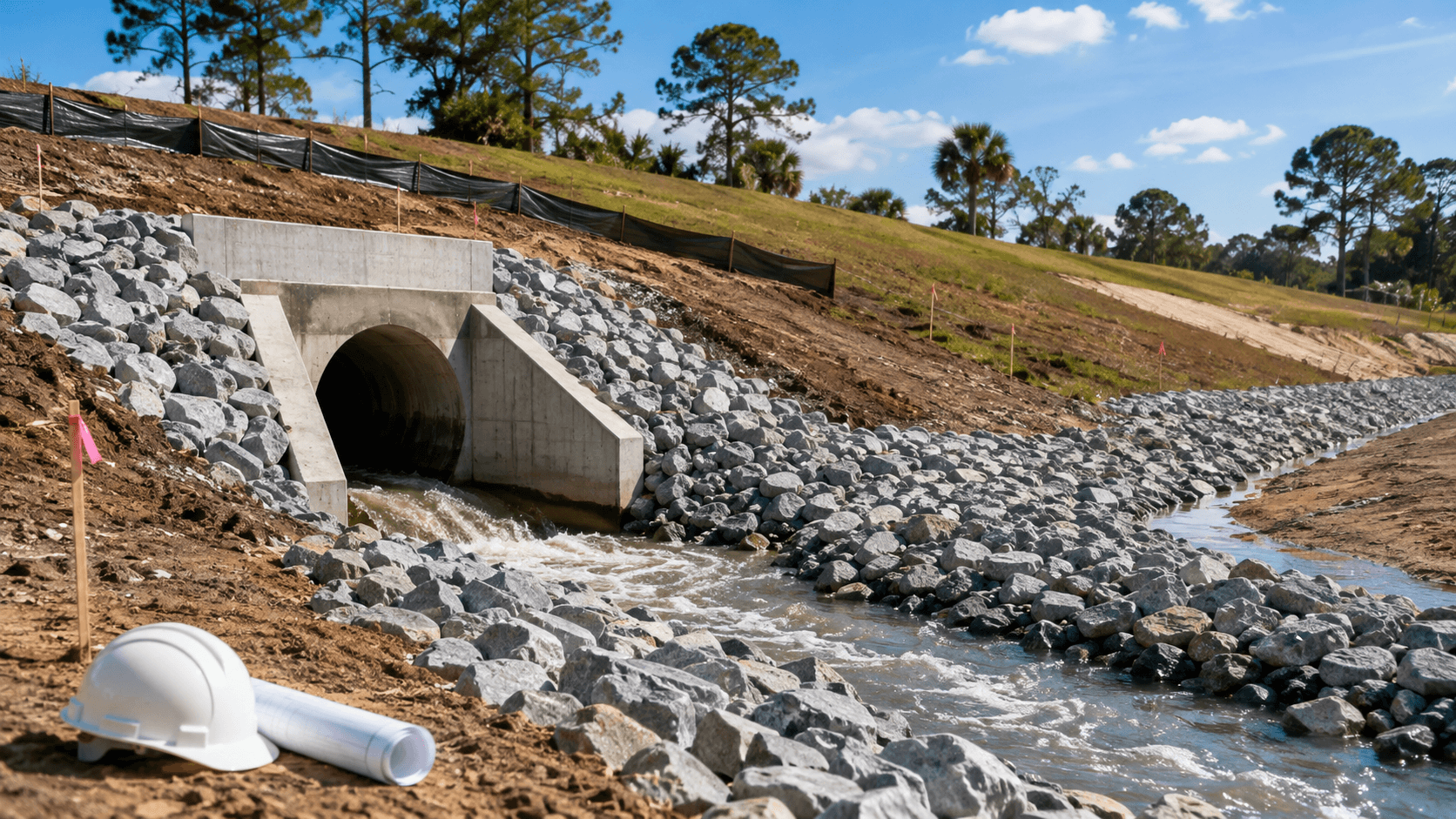
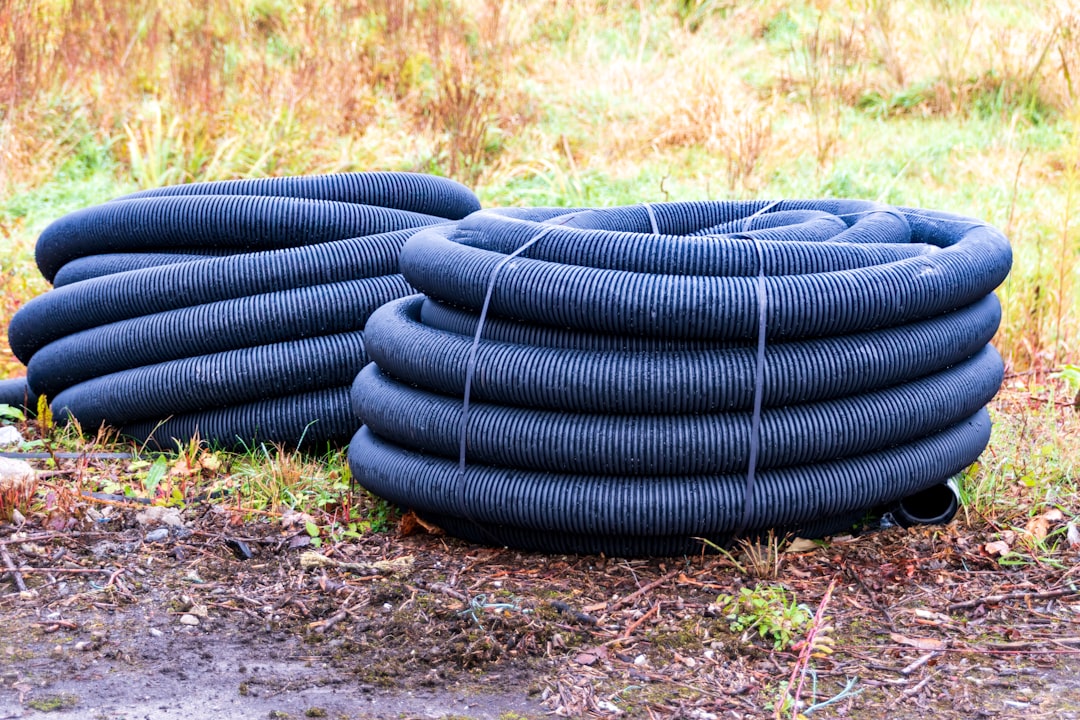
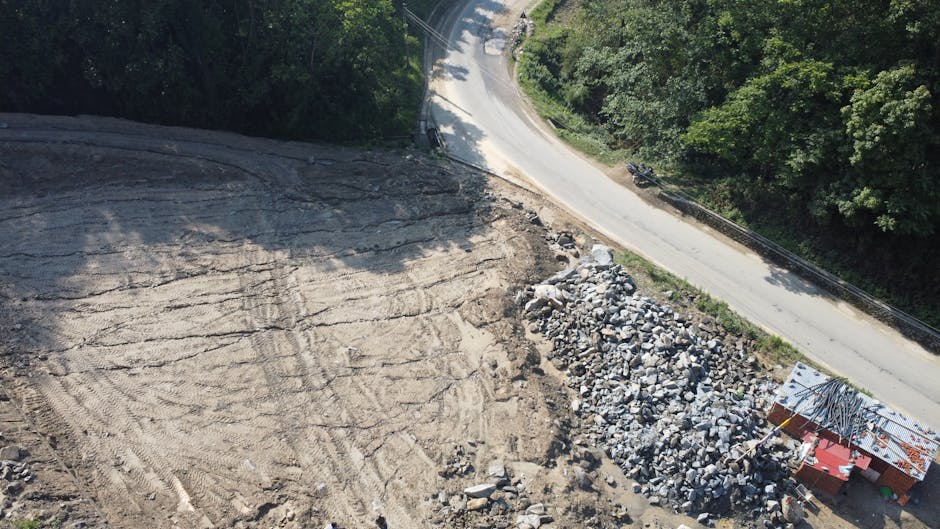
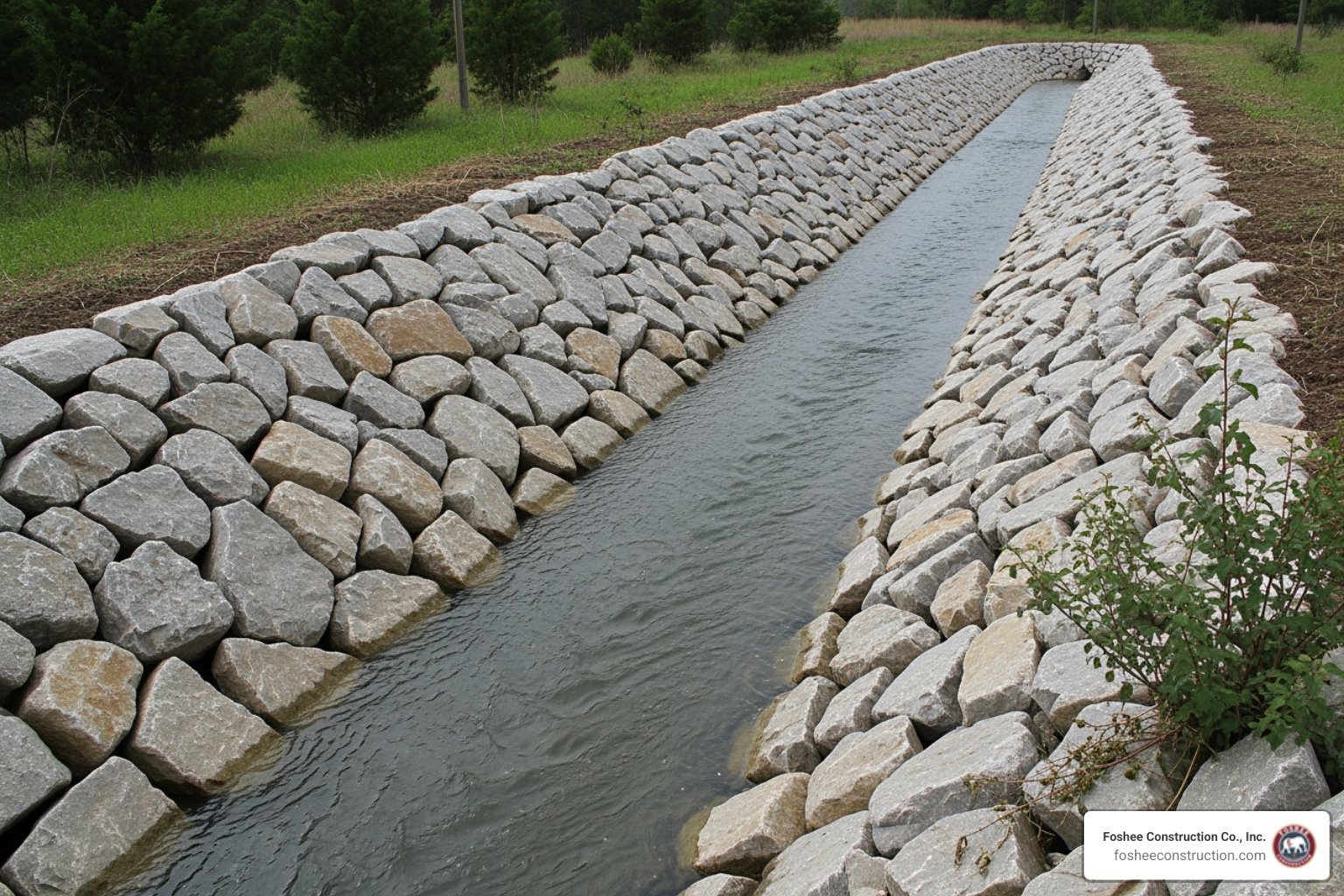
Rip rap serves as heavy-duty armor stone designed specifically to withstand severe hydraulic force. The secret to its structural stability lies in the angularity of the fractured rock. Unlike smooth, rounded river pebbles that roll past one another when submerged in rushing water, angular quarry stone pieces lock together mechanically. This open, interlocking matrix creates a durable barrier that breaks up water velocity while allowing water to pass through freely, preventing destructive hydrostatic pressure behind embankments.

Selecting the right aggregate requires balancing material density, rock composition, and gradation sizing. As we often emphasize when choosing the right riprap size for your drainage project, using stone that is too small results in hydraulic displacement during major storms, while oversized rock creates excessive voids that complicate shallow grading.

Material TypeTypical Sizing RangeDensity (lbs/cu yd)Primary Structural CharacteristicsCommon Florida Applications
Limestone Rip Rap4" to 12"+ (Softball to soccer ball+)~2,600 - 2,800 lbsAngular, self-interlocking, highly available locallyRetention basins, drainage swales, culvert aprons, pond banks
Granite Rip Rap5" to 10"+ (Class A / Heavy Armor)~2,700 - 2,900 lbsExtremely hard, low absorption, high compressive strengthHigh-velocity channels, bridge abutments, heavy scour zones
Recycled Concrete4" to 12"+ (Oversized crushed concrete)~2,400 - 2,600 lbsCost-effective, angular, sustainable, permeable void structureTemporary construction entrances, ditch checks, bank stabilization

Material Variations: Limestone, Granite, and Recycled Concrete

Florida sitework relies heavily on regional aggregate geology. The three most common material types you will encounter when sourcing rip rap include:

  • Crushed Limestone: Sourced widely from Florida quarries, native limestone is an economical, high-performing aggregate for stormwater management. Its jagged, fractured edges interlock tightly under load. Because limestone is regionally abundant throughout Florida, it delivers exceptional erosion defense with lower freight costs compared to imported igneous stone.
  • Granite Rock: Granite is a denser, non-porous igneous rock known for high compressive strength and extreme resistance to mineral weathering. While granite must often be brought in from regional distribution hubs outside the immediate peninsula, its dense mass makes it suitable for extreme water velocity environments and high-volume commercial outfalls.
  • Recycled Concrete Aggregate: Concrete Rip Rap - Gulf States Materials is an oversized recycled concrete material commonly used for erosion control, slope protection, and structural stabilization. Crushed concrete provides an environmentally sustainable, budget-friendly alternative to virgin quarried rock. Its jagged surfaces interlock effectively, providing the open void space necessary to dissipate water energy along embankments and temporary construction access paths.

Common Sizing Standards: From Class A to Heavy Armor Stone

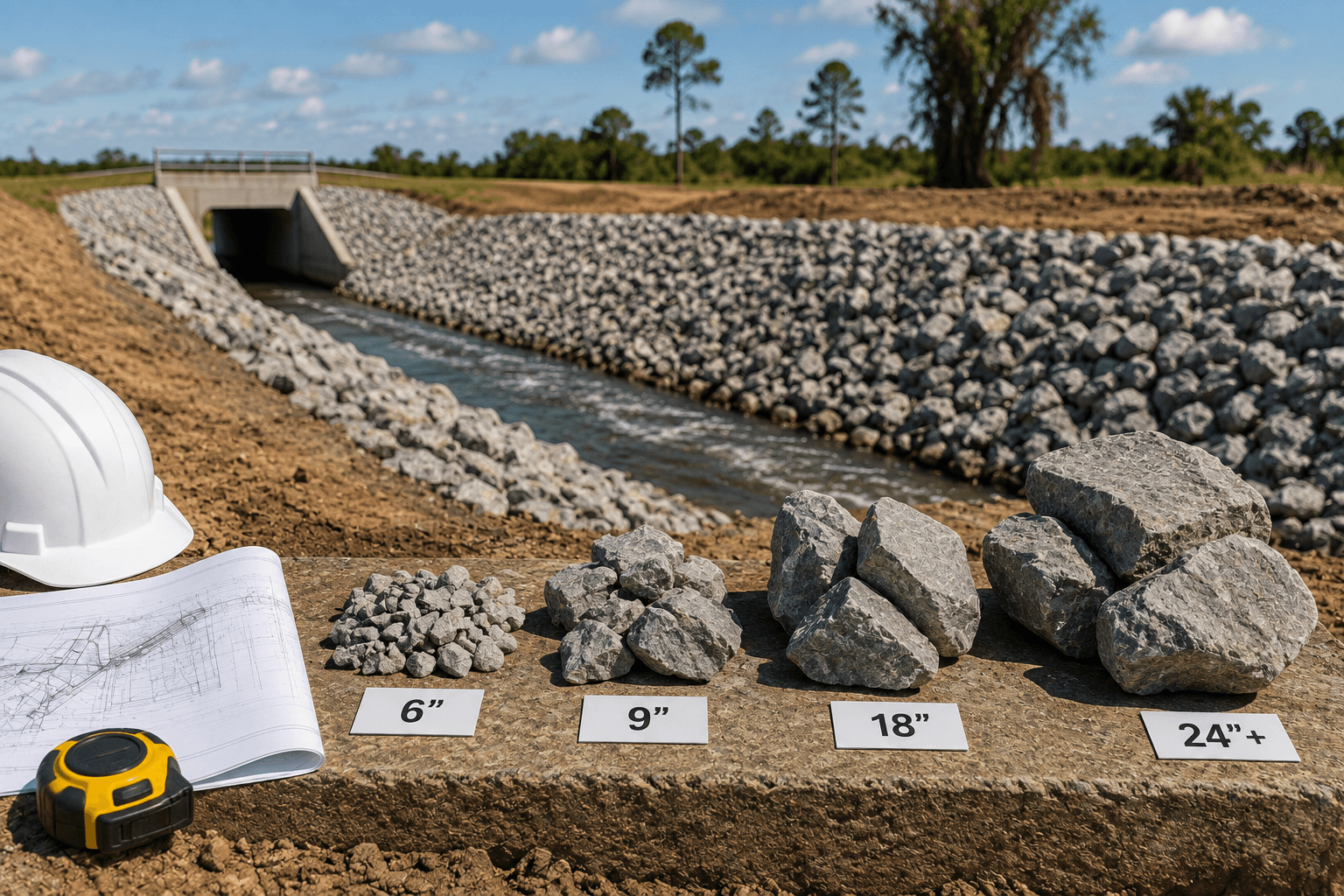
Rip rap is classified by size gradations rather than uniform single-cut dimensions. Sizing can range from the diameter of a softball (4 to 6 inches) to a soccer ball (8 to 12 inches) and up to massive boulder-sized armor stone:
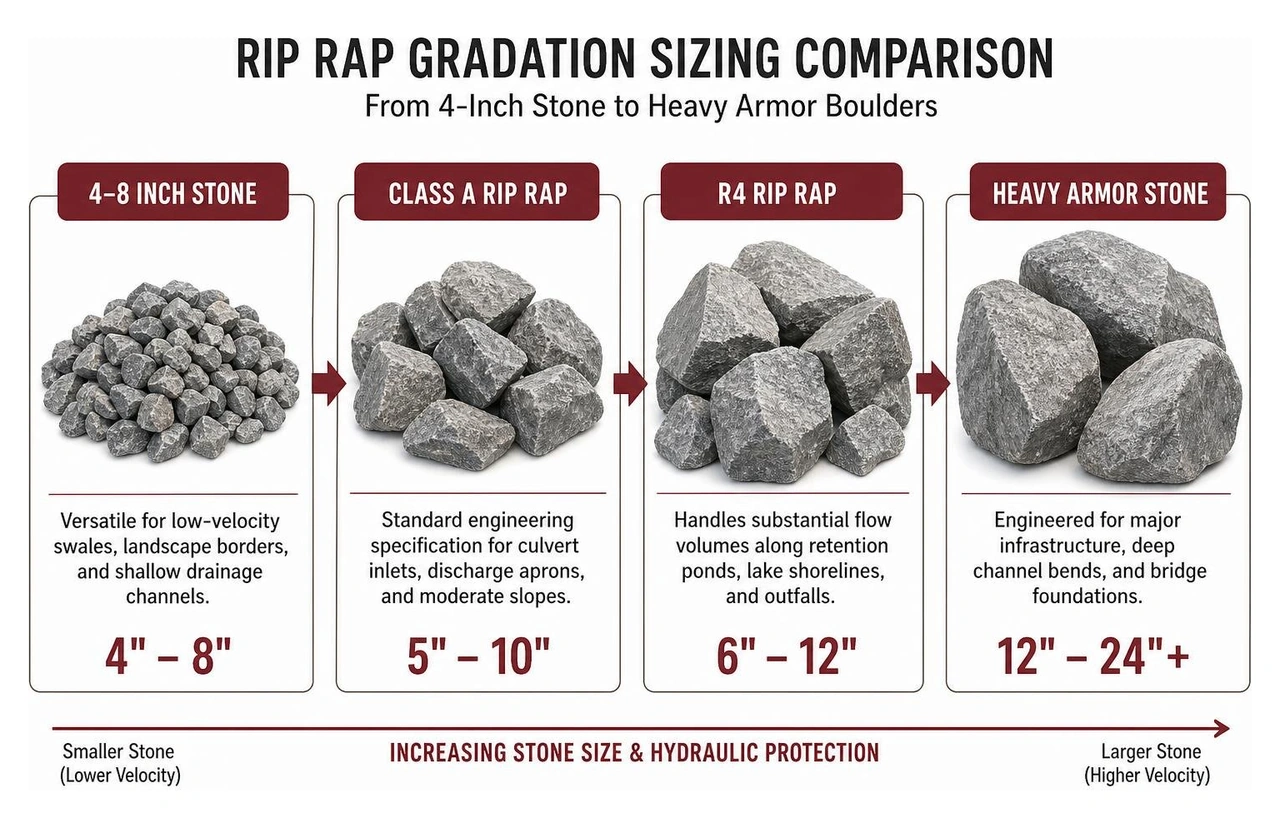
  • 4-to-8 Inch Stone: A versatile residential and light commercial size frequently specified for low-velocity swales, landscape bed borders, and shallow drainage channels.
  • Class A Rip Rap (5-to-10 Inch): A standard engineering specification consisting of angular 5-to-10 inch rock. One ton of Class A stone yields roughly 20 cubic feet of volume, making it a reliable standard for culvert inlets, discharge aprons, and moderate slope stabilization.
  • R4 Rip Rap (6-to-12 Inch): Sized between 6 and 12 inches, R4 stone handles substantial flow volumes along retention pond perimeters, lake shorelines, and turbulent stormwater outfalls.
  • Heavy Armor Stone (12-to-24+ Inch): Engineered for major infrastructure, deep channel bends, and bridge foundations exposed to persistent hydraulic scouring.

Rip rap gradation sizing comparison from 4-inch stone to heavy armor boulders

Rip Rap Pricing Breakdown: Per Ton, Cubic Yard, and Scoop Costs

Material costs for rip rap vary depending on whether your supplier bills by the ton, the cubic yard, or by individual equipment scoops. Understanding these unit metrics is key to budgeting your site prep:

  • Per Cubic Yard Pricing: Standard crushed limestone rip rap typically ranges from $65.00 to $79.00 per cubic yard for sizes between 4 and 9 inches. For example, Rip Rap 5-9" | The Gravel Company provides oversized, durable stone designed to control erosion, where one cubic yard covers approximately 70 to 90 square feet at 3 inches deep. Similarly, Rip Rap Rock | Erosion Control | MA South Shore Area notes regional yardage rates around $65 per cubic yard for 4-to-8 inch stabilization stone.
  • Per Ton Pricing: When billed over certified quarry scales, Class A granite or dense limestone rip rap generally runs between $70.00 and $90.00 per ton. Because large stone contains significant void space, one ton of 5-to-10 inch stone will yield roughly 20 square feet of finished coverage when laid at a standard 12-inch depth.
  • Per Scoop Pricing: Smaller landscape supply yards sell stone by loader scoops (typically 1/2 to 1 cubic yard per bucket), often priced around $65.00 to $70.00 per scoop, with volume discounts applied to commercial purchases of 25 scoops or more.

Understanding the fundamental mechanics behind these materials—and reviewing what is rip rap erosion control—ensures you select the most cost-efficient aggregate class for your specific hydraulic conditions.

Delivery Logistics, Freight Minimums, and Truckload Capacities

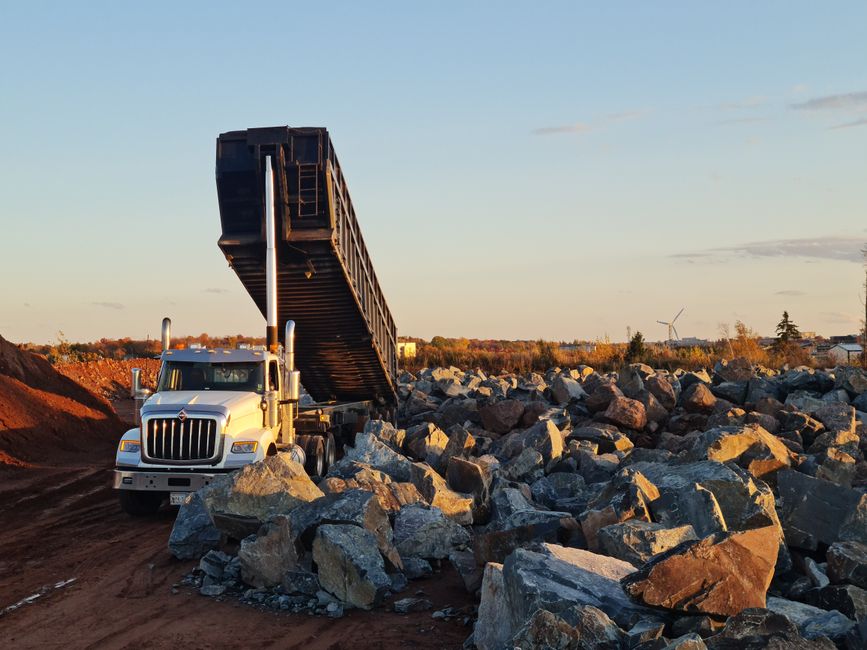
Rip rap is a heavy, high-volume bulk product. Dump truck freight logistics are a major part of overall material procurement:

  1. Truckload Capacity: A standard commercial tri-axle dump truck hauls between 18 to 22 tons (roughly 14 to 16 cubic yards) per load, depending on axle limits and road restrictions.
  2. Minimum Order Thresholds: Most bulk aggregate suppliers require minimum orders of 3 to 5 cubic yards (or 3 to 5 tons) for residential or small-scale commercial dispatch. Smaller quantities often incur partial-load freight surcharges.
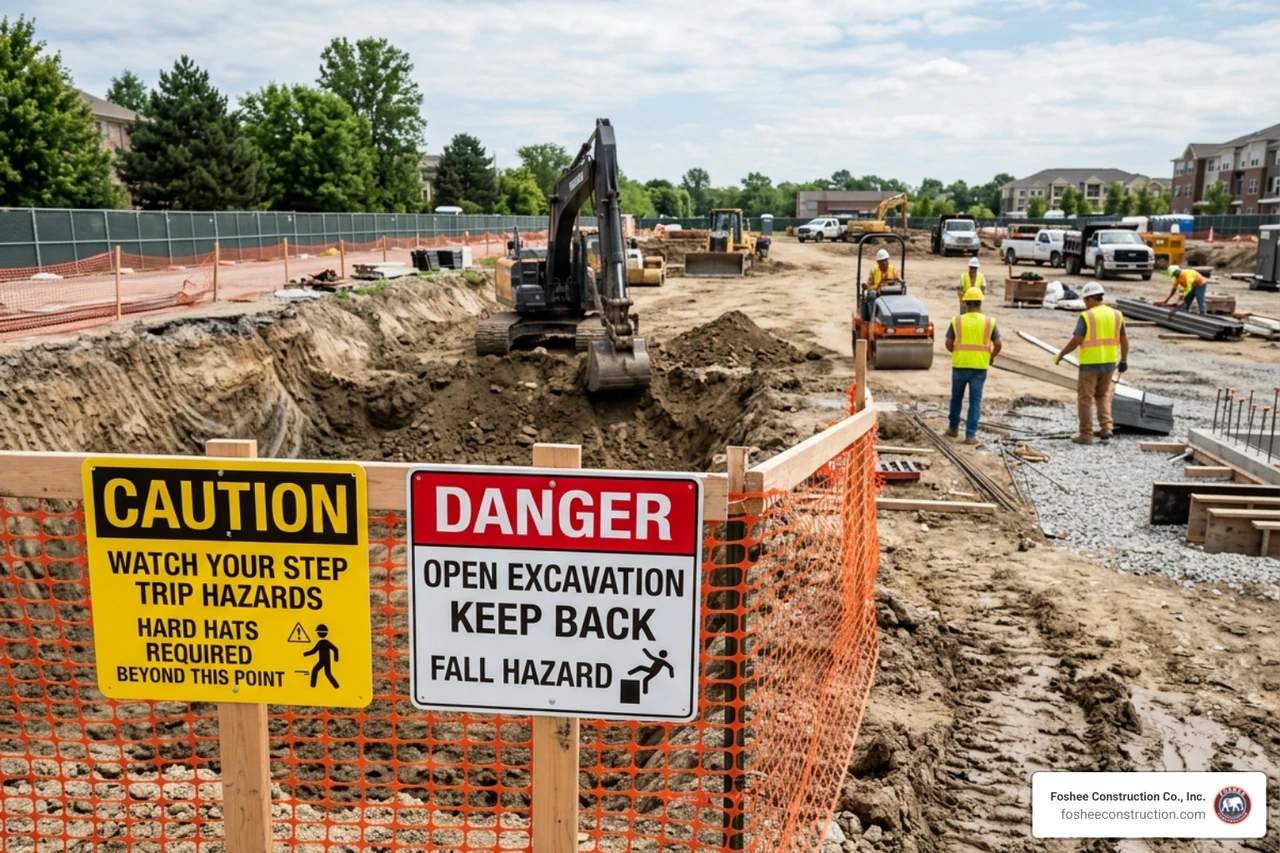
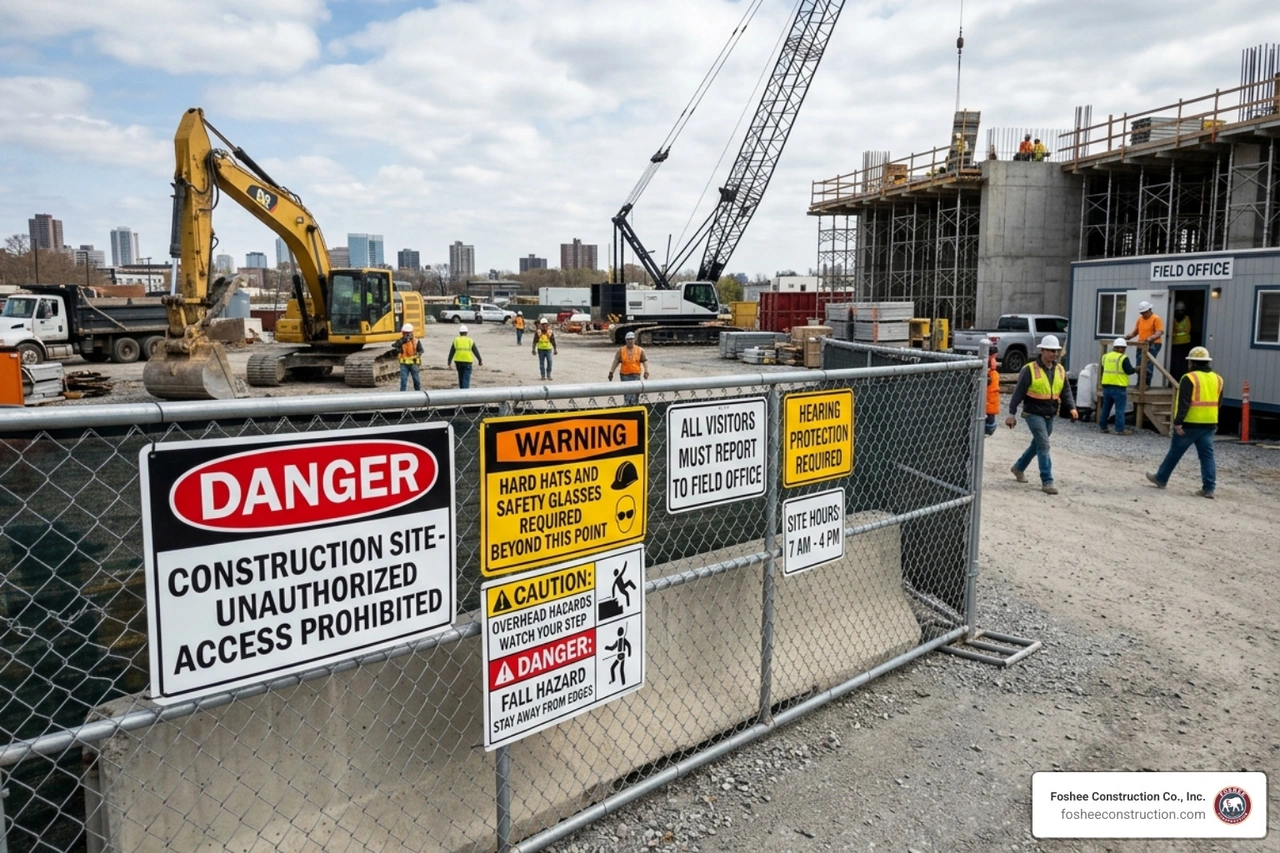
  3. Site Access and Safety: A loaded tri-axle weighs over 65,000 pounds. Soft sandy subgrades, overhead utility lines, and narrow residential cul-de-sacs can restrict direct access. Ensure drop locations are level, firm, and clear of overhead hazards.
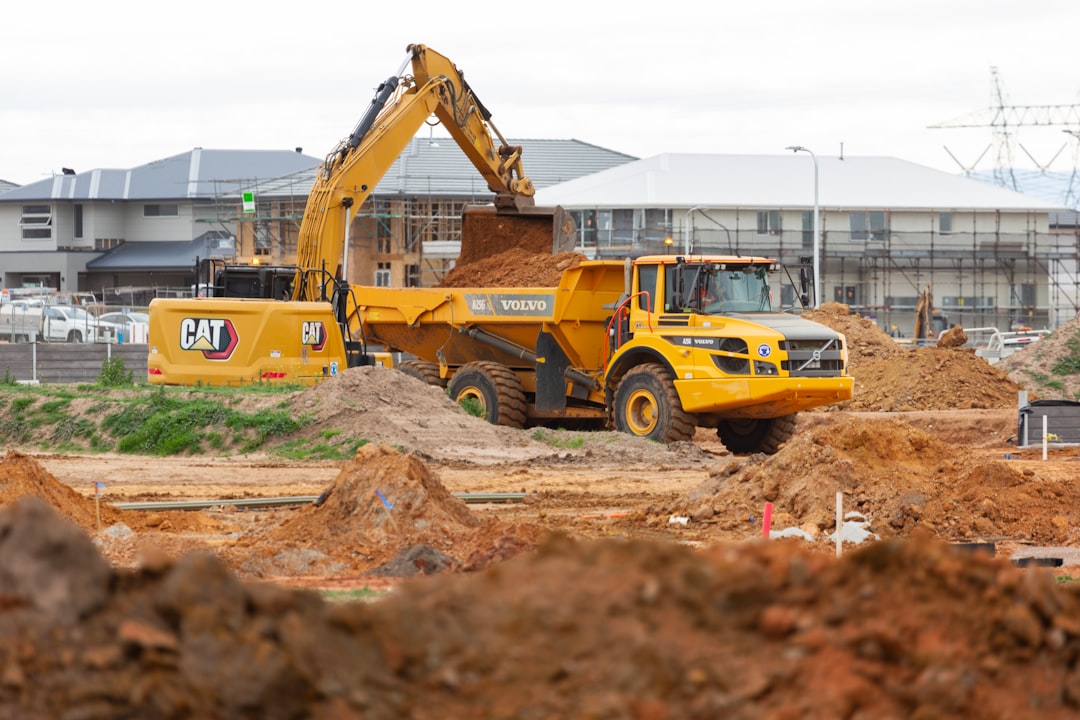
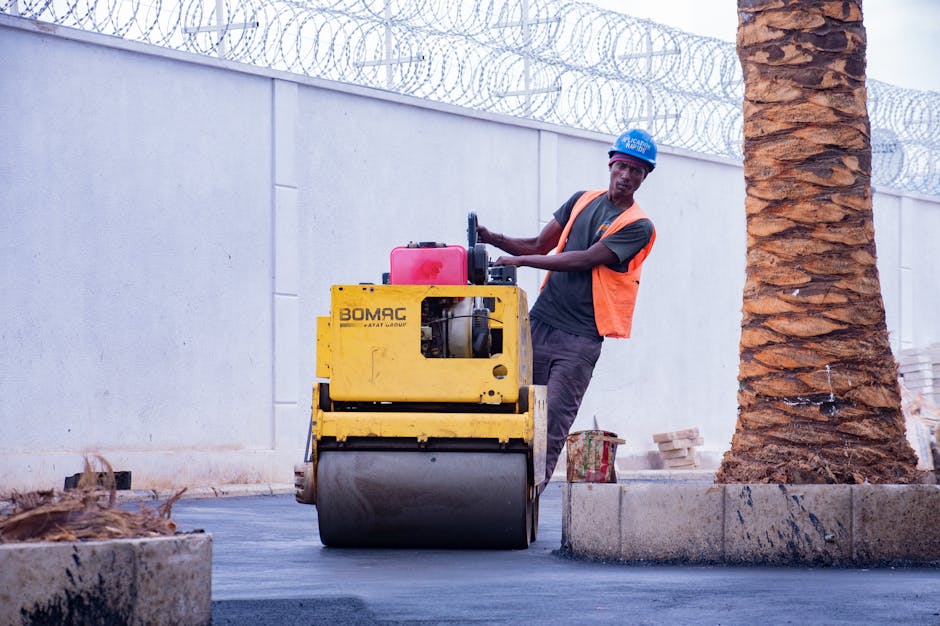
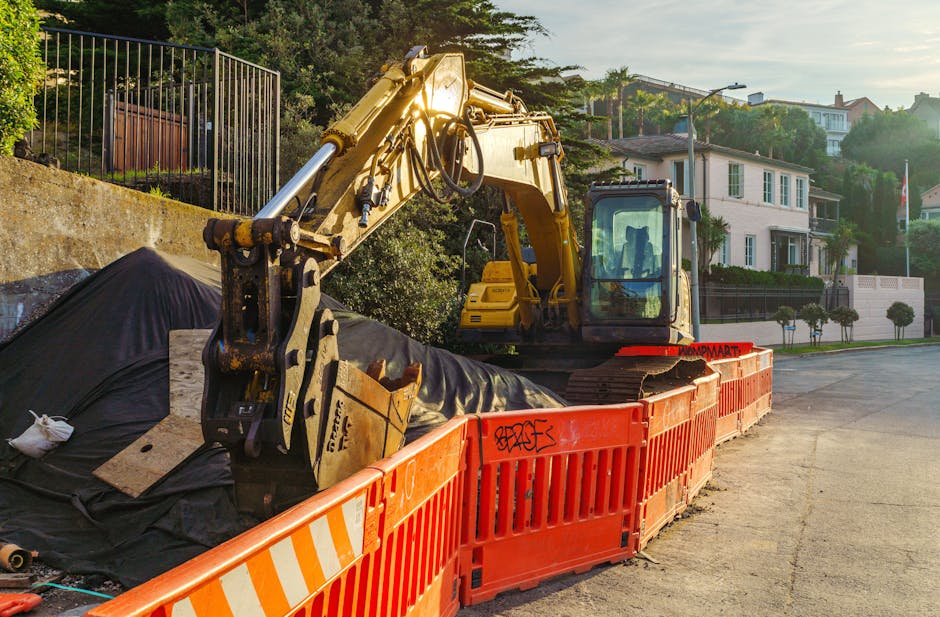
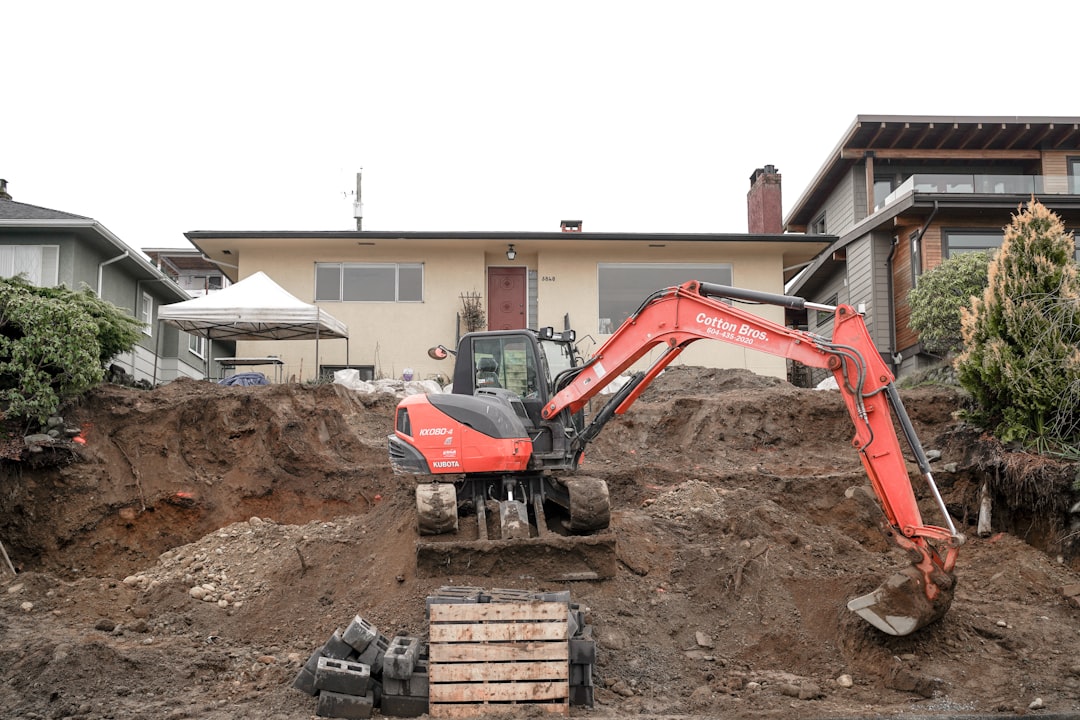
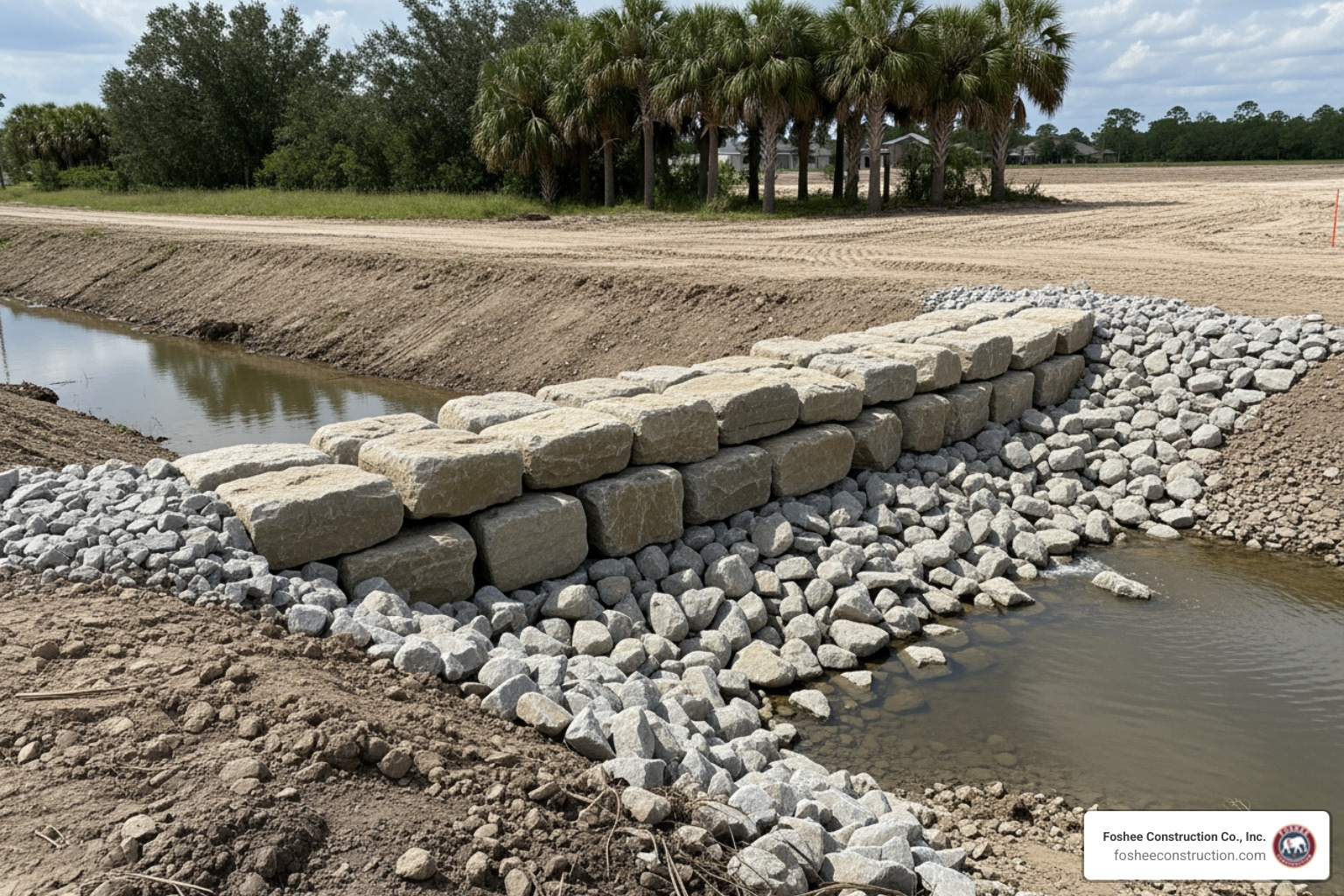
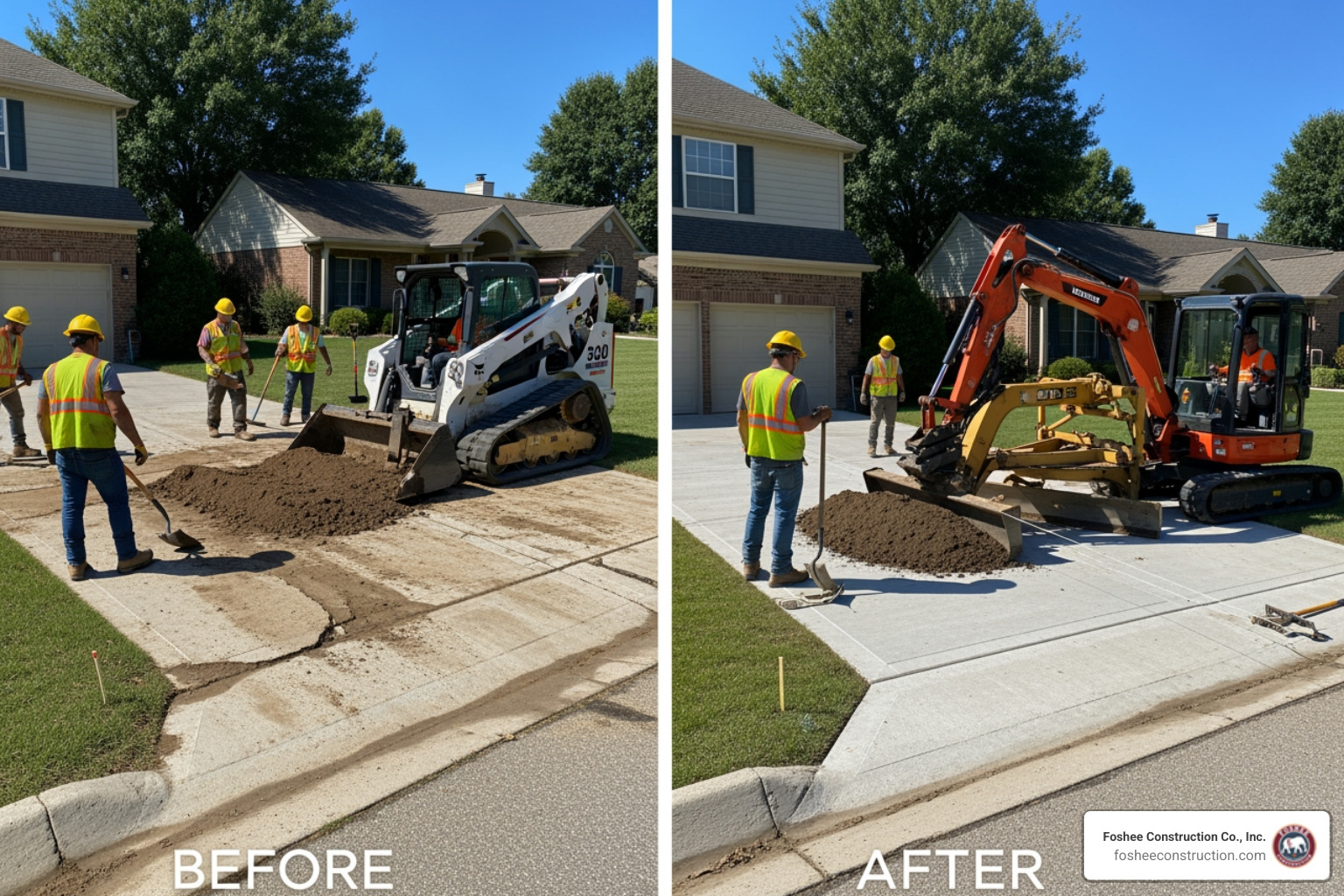
  4. No Tailgate Spreading: Unlike fine road base or crusher run, drivers cannot safely "tailgate spread" 6-to-12 inch stones out of a dump bed. Rip rap dumps into concentrated piles and must be distributed across the slope using an excavator, skid steer, or loader. Working with an experienced grading and drainage contractor ensures mechanical placement matches your engineered site elevations.

How to Calculate Material Volume and Tonnage Requirements

Accurately calculating your aggregate order prevents mid-project delivery delays or paying freight on surplus rock. Use this standard formula:

$$\text{Cubic Yards} = \frac{\text{Length (ft)} \times \text{Width (ft)} \times \text{Depth (ft)}}{27}$$

  • Step 1: Determine Installation Depth: For standard 4-to-8 inch or 5-to-10 inch rip rap, plan on a minimum installation thickness of 12 inches (1.0 ft) to ensure full interlock and proper bed protection.
  • Step 2: Add a 10% Contingency Buffer: Always incorporate a 10% safety buffer to account for stone settling into the subgrade, void variability, and slope slope irregularities.
  • Step 3: Convert Volume to Tonnage: Since standard rip rap weighs approximately 2,600 to 2,800 lbs per cubic yard (1.3 to 1.4 tons/yd), multiply your total calculated cubic yards by 1.35 to find total required tons.

Sourcing Rip Rap Near Me: Local Suppliers vs. Direct Quarry Pickup

Property owners and site contractors across Central Florida have two primary procurement channels: purchasing from local retail aggregate yards or setting up direct freight from commercial mining quarries.

When searching for the best local source, look for established material networks like Gravel, Sand and Topsoil in Minneola, Lake County, Florida or regional suppliers offering Gravel, Sand and Topsoil in Eustis, Lake County, Florida - Gravelshop. Local supply yards are well-suited for smaller orders (under 10 tons) or specialized deliveries, whereas direct quarry transport is the most economical route for multi-truck commercial developments.
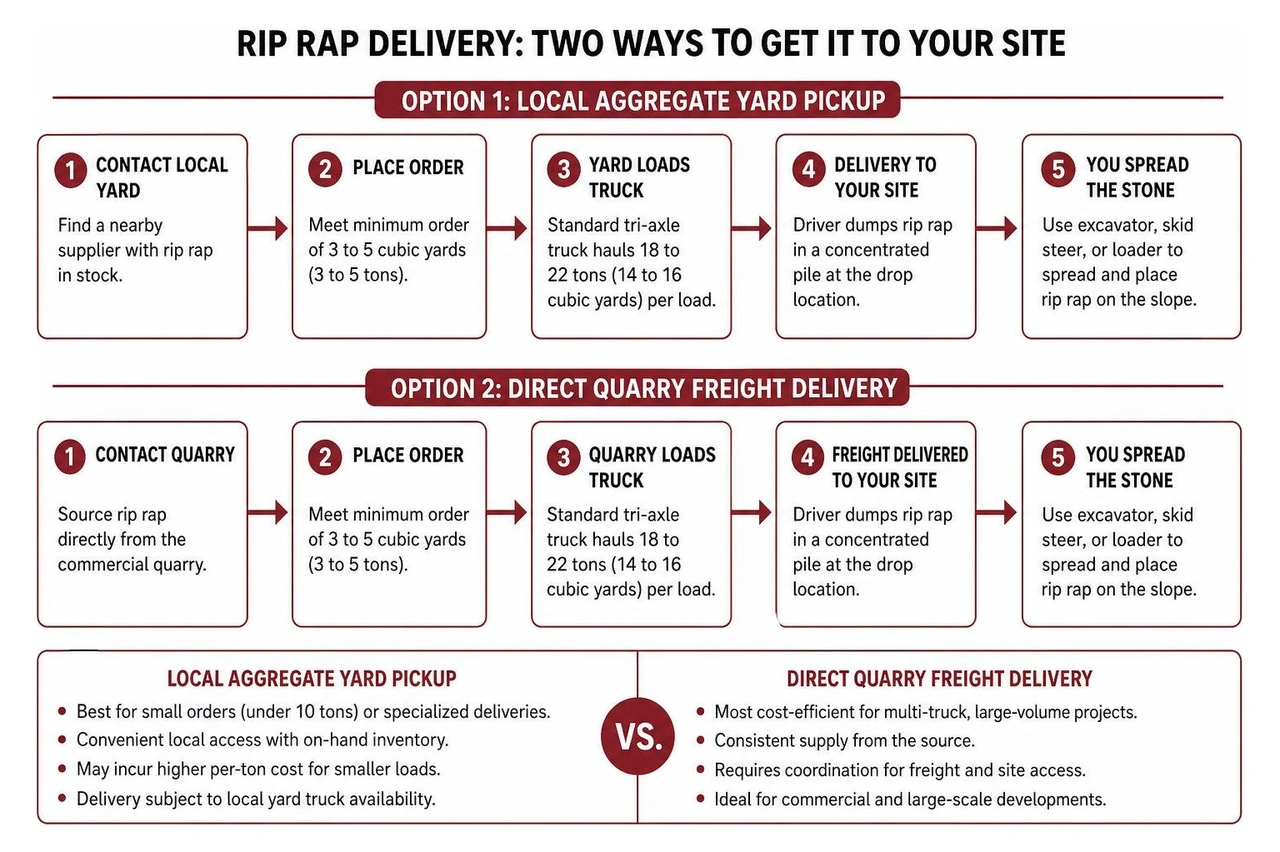
Process flowchart comparing local aggregate yard pickup versus direct quarry freight delivery

How to Find and Vet Bulk Rip Rap Near Me

Not all rock piles are created equal. When sourcing aggregate locally, evaluate your supplier across four key quality metrics:

  • Gradation Consistency: Confirm whether the supplier stocks graded rip rap (screened to strict minimum and maximum diameter thresholds) or random / run-of-crusher rip rap (a mixed blend containing fine gravel and oversized stone). Graded stone provides superior interlock for high-flow engineering projects.
  • Verified Scale Weights: Ensure the facility utilizes state-certified truck scales and provides automated scale tickets stamped with tare, gross, and net weights upon departure.
  • Haul Route Capabilities: Verify that the hauling company maintains a modern fleet capable of handling heavy bulk transport without tearing up local curbs, sidewalks, or unpaved haul roads. Integrating aggregate deliveries with professional site preparation services ensures the site is prepped and accessible before trucks arrive.
  • Material Certification: For municipal or civil drainage projects, confirm the quarry's rock meets FDOT specifications for specific gravity, absorption, and soundness.

Key Questions to Ask When Ordering Rip Rap Near Me

Before finalizing an aggregate order, ask your supplier or hauling dispatcher the following questions:
  • What is the exact size gradation (e.g., 4"-8", 6"-12", Class A) of the material currently in your stockpile?
  • Are your prices quoted per ton (2,000 lbs) or per cubic yard, and does the quote include fuel surcharges and delivery fees?
  • What is the minimum tonnage required to avoid a short-load freight fee?
  • How many days of advance notice do you require for tri-axle dispatch?
  • Can your drivers safely stage dumps in specific staging areas on-site, or is delivery restricted to curbside drop-off?

Engineering and Installation Best Practices for Long-Term Erosion Defense

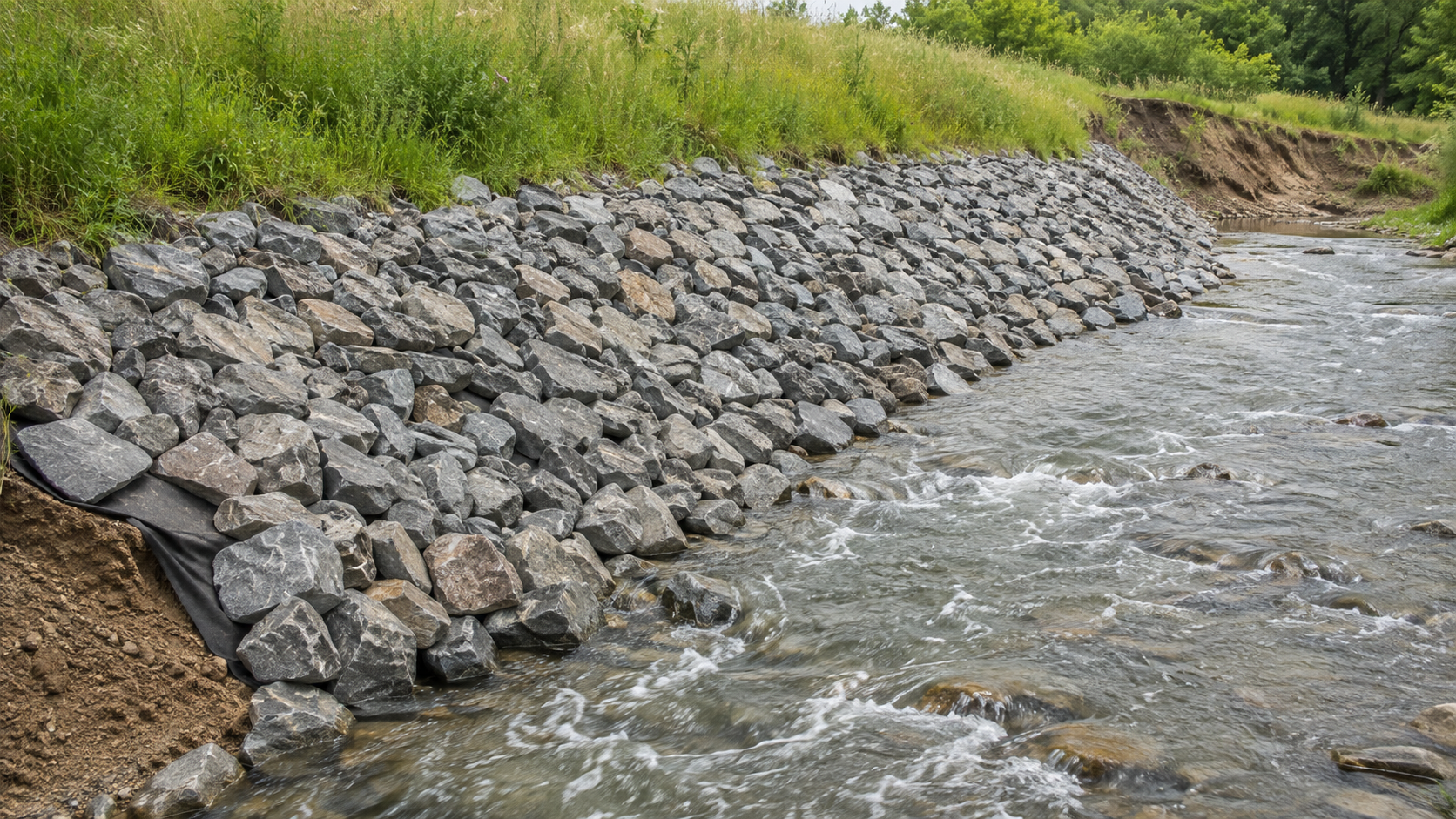
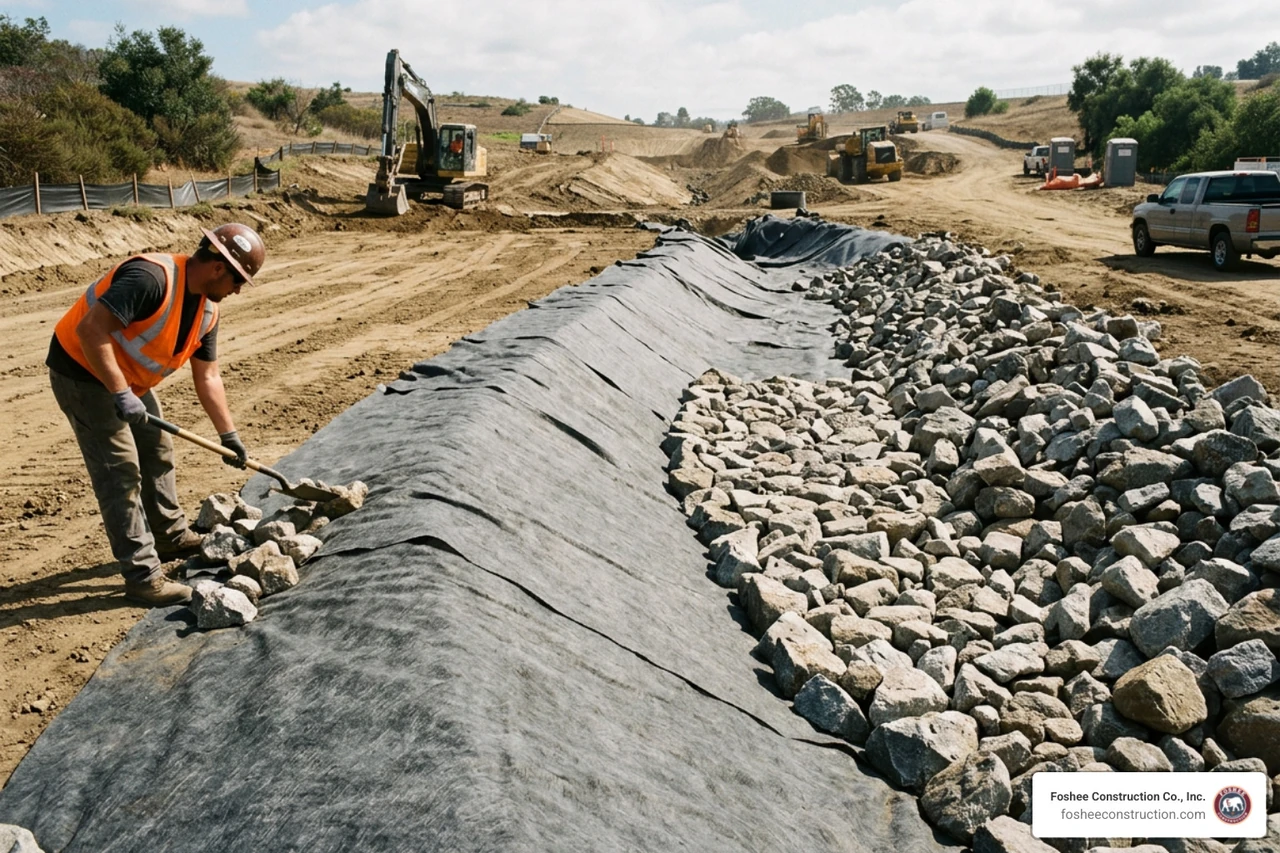
non-woven geotextile underlayment placed beneath rip rap

Dumping heavy rocks directly onto bare dirt will not solve erosion issues. Over time, water turbulence washes loose sand and subgrade soil right through the open voids between rocks. The heavy stones gradually sink into the mud, and the embankment fails.

A reliable installation requires establishing a complete structural system, typically detailed within an engineered erosion control plan ultimate guide.

Sub-Base Grading, Excavation Depth, and Geotextile Underlayment

Proper installation follows a strict sequence of site preparation:

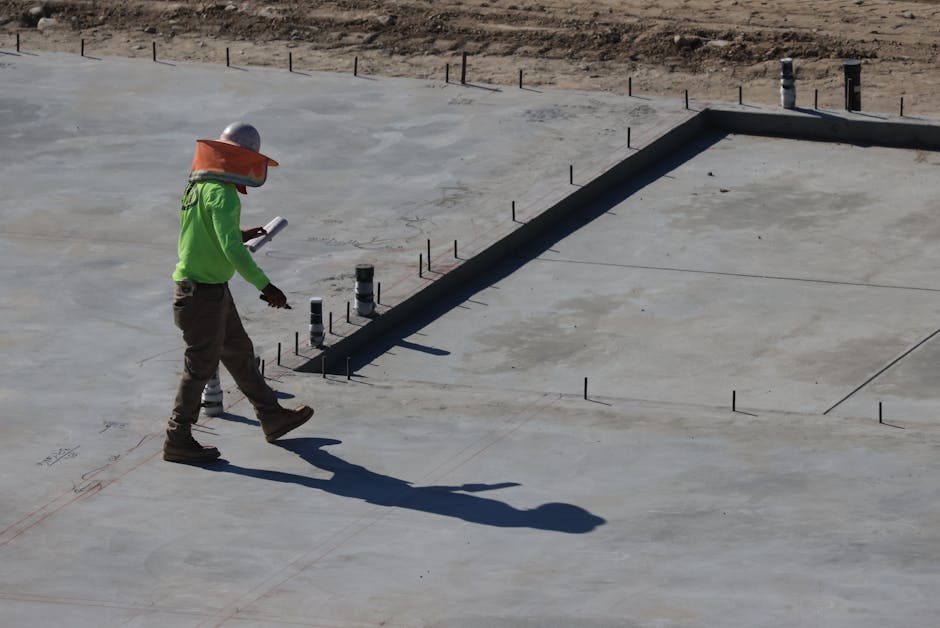
  1. Subgrade Excavation: Excavate the project area so that the finished top surface of the rip rap layer sits flush with adjacent natural grades. This prevents high-velocity water from catching and undercutting the edges of the rock revetment.
  2. Soil Compaction and Smoothing: Smooth and compact the underlying soil base, removing sharp tree roots, large organic debris, and sharp rocks that could puncture fabric.
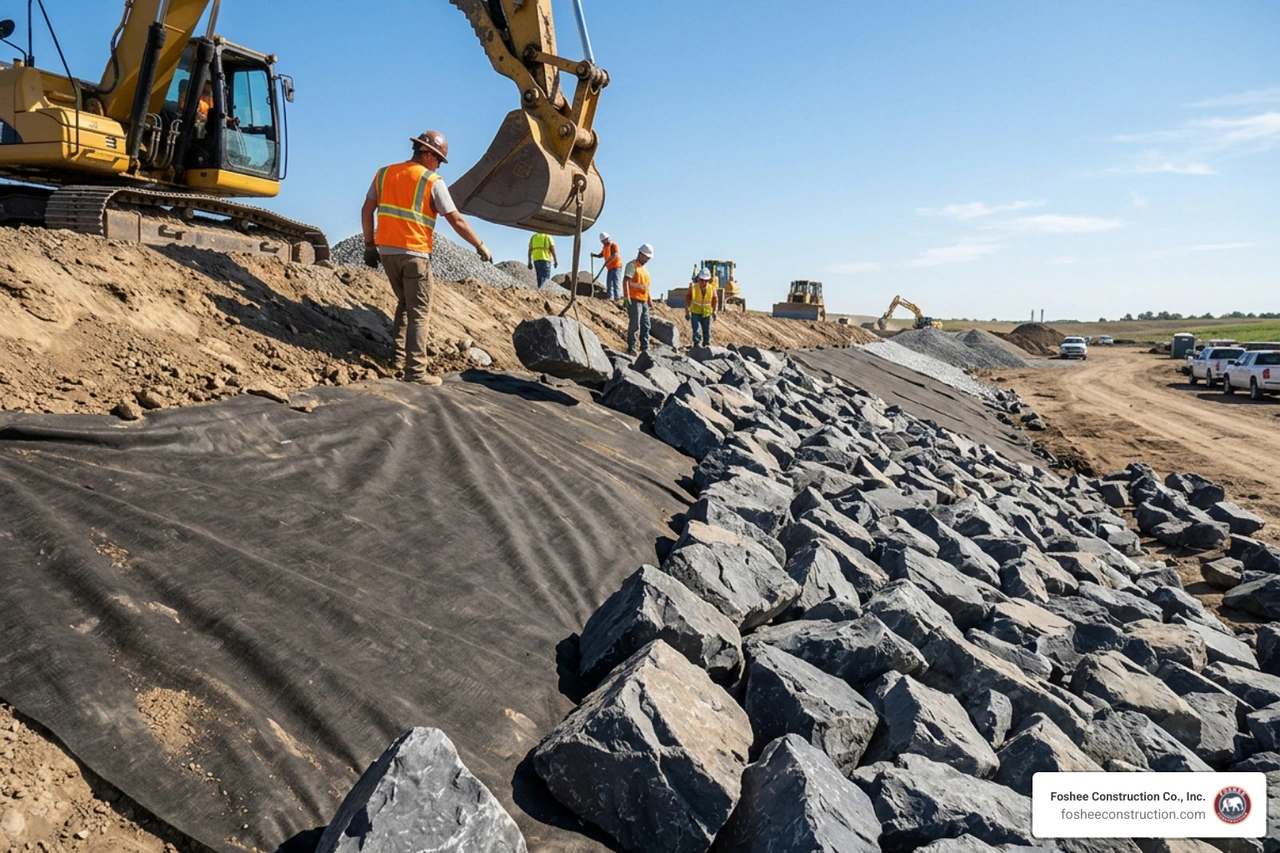
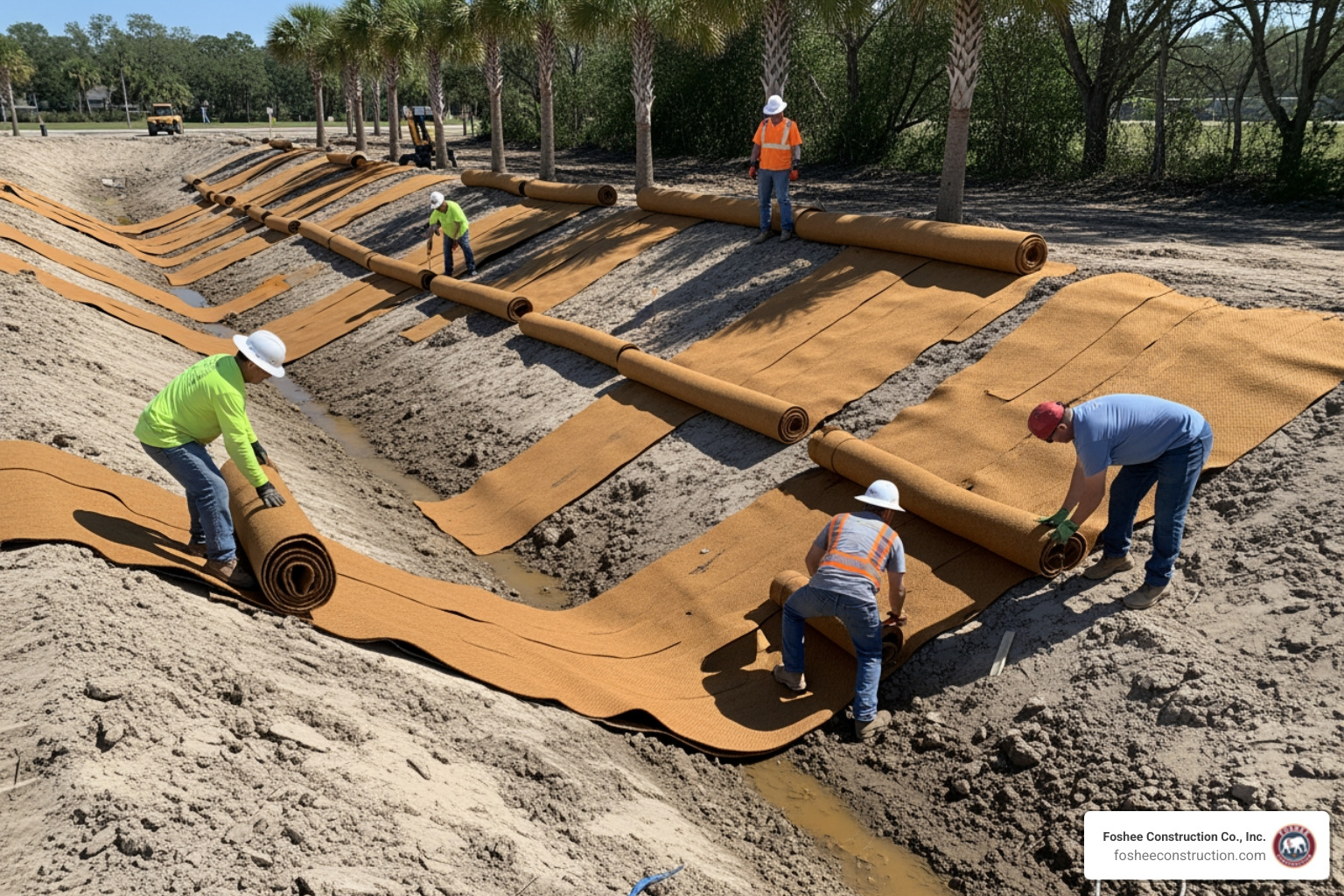
  3. Non-Woven Geotextile Placement: Lay heavy-duty, needle-punched non-woven geotextile filter fabric across the excavated grade. The fabric acts as a permanent separation barrier—it permits groundwater to drain through freely while stopping fine soil particles from washing away. Overlap all fabric seams by a minimum of 12 to 18 inches in the direction of anticipated water flow.
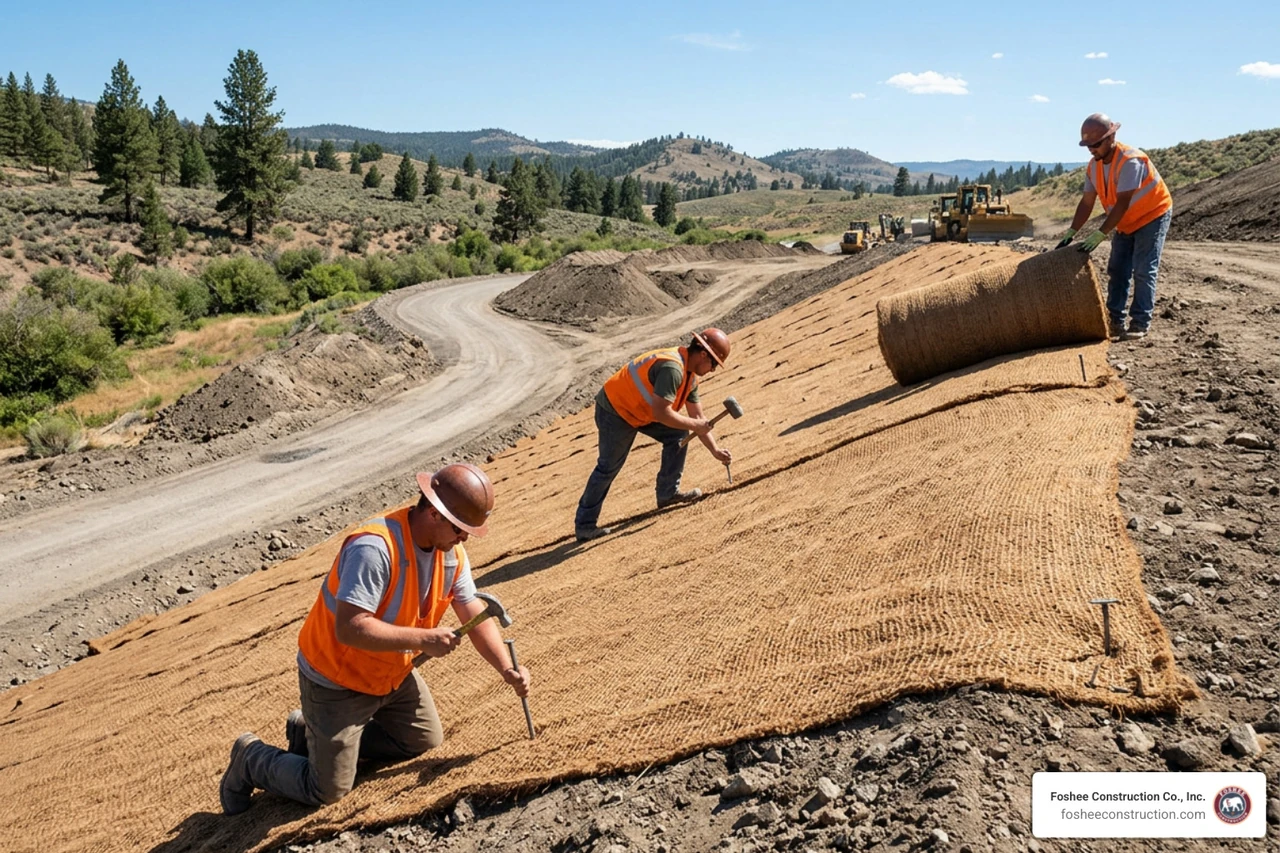
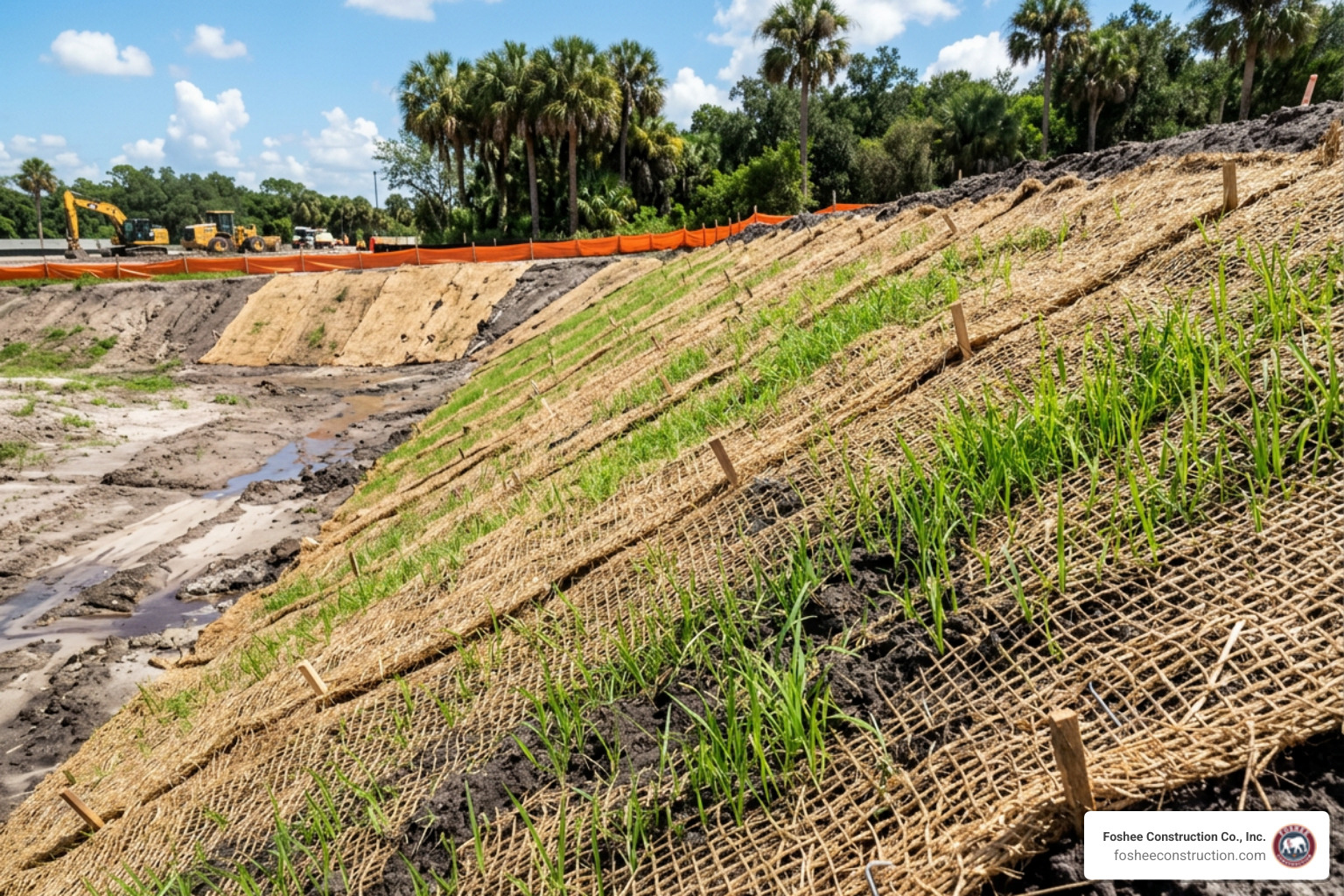
  4. Keying the Edges: Dig a 12-to-18-inch anchor trench (toe trench) at the top and bottom of the slope. Tuck the geotextile edges into the trench and pin them securely before filling with stone. Following proper erosion control blanket installation guide techniques on upper slope banks ensures surrounding soils remain stable while rock work proceeds.
  5. Stone Placement: Place rock using an excavator bucket or loader, keeping drop heights under 3 feet to prevent tearing the underlying geotextile fabric. Hand-adjust stones where necessary to interlock the surface.

Comparing Rip Rap to Gravel, Surge Stone, and Alternative Erosion Controls

Understanding how rip rap differs from other quarry materials ensures you select the correct aggregate for the job:

  • Rip Rap vs. Traditional Gravel: Standard gravel (such as #57 limestone, sized 1/2" to 1") is engineered for flat pipe bedding, driveways, and basic water drainage. It lacks the mass to withstand concentrated surface runoff. Gravel manages low water flows; rip rap controls heavy hydraulic forces.
  • Rip Rap vs. Surge Stone: Surge stone typically ranges from 2 to 4 inches in diameter. While useful as a bedding layer or for light drainage swales, surge stone will wash away under the hydraulic velocities commonly found at stormwater outfalls and pond overflows.
  • Rip Rap vs. Crusher Run: Crusher run (dense grade aggregate) contains crushed rock blended with fine stone dust, designed to compact into a solid, unyielding driveway or road base. In contrast, rip rap contains zero fine particles, maintaining an open void structure that dissipates kinetic water energy.
  • Rip Rap vs. Check Dams: For concentrated drainage swales during active earthmoving, building structured erosion control rock check dams slows down runoff and catches suspended sediment before it reaches protected wetlands or retention ponds.

Frequently Asked Questions About Sourcing Rip Rap

How deep should a rip rap layer be installed for erosion control?

As a general engineering rule, the total thickness of a rip rap revetment should be 1.5 to 2.0 times the maximum stone diameter in the gradation, with a baseline minimum thickness of 12 inches. For instance, an installation utilizing 5-to-10 inch rock should be placed at a depth of 12 to 15 inches. This ensures sufficient stone overlap to prevent exposed gaps, resist hydraulic uplift, and provide reliable long-term protection.

Is non-woven geotextile fabric always required under rip rap?

Yes. In nearly all civil and commercial erosion control applications, non-woven geotextile filter fabric is necessary beneath rip rap. Without an underlayment fabric, water flowing across the channel will scour fine soil particles through the rock voids. This process—known as soil piping—causes the armor stone to settle unevenly and sink into the subgrade, leading to slope failure.

What is the coverage rate of one ton of rip rap?

Coverage depends on stone size and installation depth:

  • At 12 inches deep (standard for 5-to-10" Class A stone): One ton yields roughly 20 cubic feet, covering approximately 20 square feet.
  • At 6 inches deep (for smaller 4-to-8" stone): One ton covers roughly 35 to 45 square feet.
  • At shallow depths (2 to 3 inches for decorative or light ditch lining): Coverage rates range between 50 to 60 square feet per ton, though shallow placements are unsuitable for high-velocity water channels.

Conclusion

Choosing the right rip rap supplier involves more than just finding rock. It requires matching rock gradations to your site's water velocity, coordinating heavy freight deliveries, preparing the sub-base, and installing geotextile fabric to prevent washouts. Sourcing quality rock from reputable suppliers and preparing your subgrade properly ensures your slope or shoreline stands up to severe Florida weather.

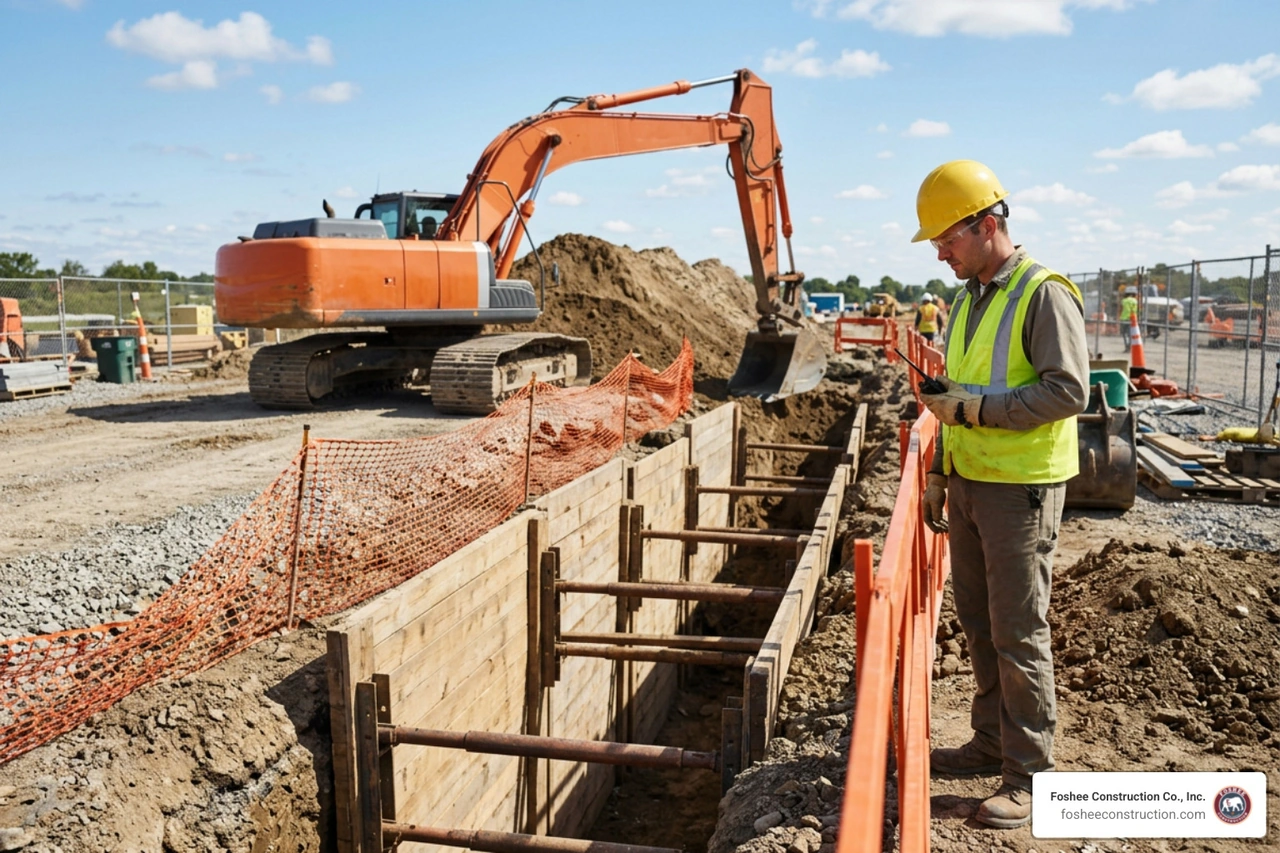
At Foshee Construction Co., Inc., we bring decades of hands-on civil excavation, grading, underground utility, and site development experience to every project across Minneola, Lake County, and Central Florida. Whether you are stabilizing retention pond banks, building culvert outfalls, or executing complete commercial earthwork, our team provides transparent bids, disciplined project scheduling, and turnkey execution.

Explore our professional erosion control rip rap solutions or connect with our team today to schedule an on-site evaluation for your next site development project.

Latest Posts

How We Work Differently

Bid Smarter With the Right Tools

We build bids using HeavyBid and AGTEK because the details matter long before the job starts. When the numbers are accurate and the scope is clearly defined, it sets the tone for how the entire project runs. Estimating isn’t just a step in the process, it’s the foundation we build on.

Quality in the
Field

That same mindset carries into the field. Our crew is trained to work with purpose, follow the Civil Engineers’ Plan to the finest detail, and hold the line on quality. When expectations are clear from day one, there’s no need for shortcuts, and no confusion about how the work gets done.

Clear, Complete Bid Packages

Clients trust our bid packages because they’re complete and ready to use. Project managers know what we’re covering, what’s excluded, and how we plan to approach the job. That clarity removes friction and lets teams focus on execution instead of interpretation.

Proactive RFI Process

As part of our review process, we go into the plans before anything hits the site. We ask the questions early, resolve issues before they show up in the field, and keep RFIs moving. This approach prevents delays and protects the timeline.

Referred by the People Who Build

Over time, that consistency builds trust. Many of the people we work with today came through referrals from past projects – engineers, GCs, and superintendents who’ve seen how we operate and want the same experience again.
A New Chapter with Saga Infrastructure Solutions

In 2024, Foshee Construction was acquired by Saga Infrastructure Solutions, a national network of civil construction companies. Saga supports regional contractors by giving them access to better tools, long-term resources, and operational backing, without changing how they run day to day.

Foshee will continue to operate under its name, with the same team and field leadership in place.

“From the very time a project starts, we start that partnership. We try to catch as much as we can with the tools that we have. Not everybody is using the software platforms we are. That’s the differentiator: we’re not just bidding. We’re anticipating, problem-solving, and making sure the job runs right.”


— Don, CEO, Saga Infrastructure Solutions

Get in Touch

Foshee is now part of a broader regional strategy that includes Florida, the Piedmont Atlantic, Texas, Colorado, and the Arizona Sun Corridor. The name, crews, and standards remain. What’s improving is the support behind it.